
The Complete Odoo ERP Implementation Methodology
Most growing businesses reach a point where the old way of working stops making sense. Approvals sit in email inboxes, every team keeps its own spreadsheet, and nobody can say for sure how much stock is on the shelf or which invoices are still unpaid. That is usually the moment decision makers start looking at an ERP system like Odoo. Picking the software is an important choice, but it is only the first step. What really decides whether the project pays off is the way it gets implemented.
A clear Odoo implementation methodology gives the project a proper path, from the very first workshop to life after go live. It cuts down on surprises, keeps the budget under control, and helps your team actually use the system once it is running. In this guide, we walk through every phase of a typical Odoo ERP implementation, the mistakes that derail projects, and what to look for in a partner. If you would like expert help from planning all the way to launch, our Odoo implementation services cover the full journey.
What is an Odoo implementation methodology?
An Odoo implementation methodology is the step by step process used to plan, set up, customize, test, and launch Odoo for a specific business. It is a lot more than installing software. A good methodology connects the technology to your real goals, your daily processes, and the people who will use the system every single day.
A well defined methodology usually includes these parts:
- Business process analysis
- Module selection and planning
- Configuration and customization
- Data migration and cleanup
- Testing and validation
- User training
- Deployment and go live
- Support after launch
Experienced consultants follow a structure like this so the project stays under control and can keep growing with the business, instead of falling apart the moment new needs appear.
The 8 phases of an Odoo ERP implementation
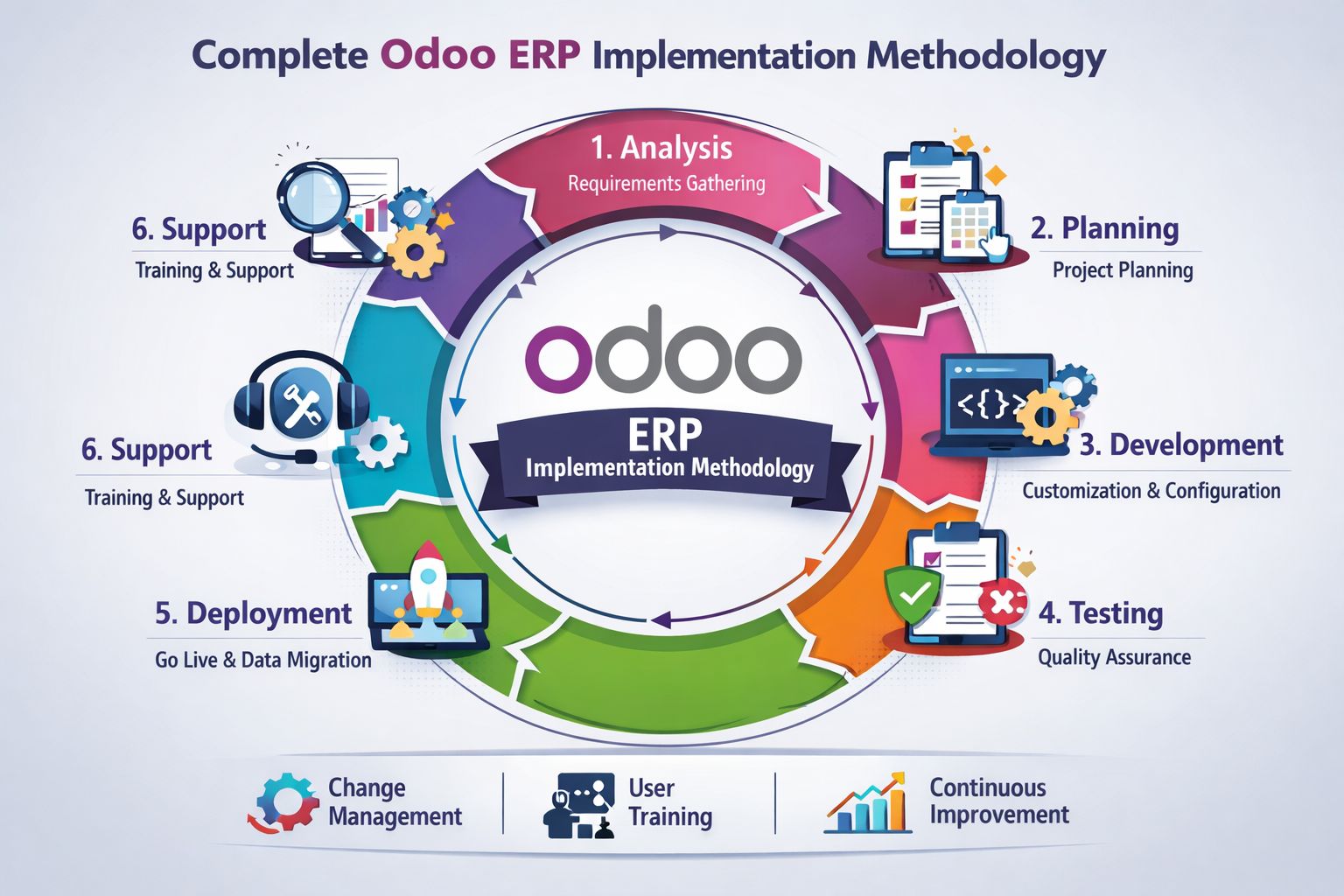
Every project is a little different, but most successful Odoo implementations move through the same eight phases. Knowing them ahead of time makes planning much easier.
Phase 1: Business analysis and requirements
Every successful project starts by understanding the business properly before anyone touches the software. Skipping this phase is one of the most common reasons ERP projects go wrong later.
Reviewing your current processes
The team looks closely at how sales, purchasing, stock movement, finance, HR, manufacturing, and reporting work today. The goal is to see exactly where work slows down and where mistakes happen most often, so the new system can fix real problems instead of copying old habits.
Common problems businesses face
Some issues show up again and again. Approvals are done by hand, data lives in separate spreadsheets, reports arrive late, stock numbers do not match, and nobody has a clear view of each customer. Naming these problems early makes every step after that much easier to plan.
Gathering requirements
Here, everyone involved sits down together to agree on the business goals, the must have features, compliance needs, how much automation is wanted, which tools need to connect, and how much room the system should have to grow. The clearer this list is, the smoother the rest of the project will be.
Phase 2: Solution design and planning
Once the requirements are clear, the design of the system begins. This is where ideas turn into a practical plan.
Choosing the right Odoo modules
Based on what the business needs, the team picks modules such as CRM, Sales, Inventory, Purchase, Accounting, Manufacturing, HR, Project, Helpdesk, and eCommerce. One of the best things about Odoo is that it is modular, so you can start with what matters most today and add more later in stages.
Standard features or customization
Many companies make the mistake of customizing far too much. A smarter approach is to use the features Odoo already includes wherever you can, and only customize the parts that are truly critical or unique to your business. When tailored changes are needed, our Odoo customization services keep them focused and easy to maintain over time.
Planning the infrastructure
The plan should also cover security, speed, flexibility, backups, and recovery from unexpected outages. This is also the stage where you decide between cloud hosting and running Odoo on your own servers, based on your budget and how much control you need.
Phase 3: Configuration and development
Now the system is set up to match the way your business really works day to day.
Configuring the modules
Each module is adjusted to fit your business rules, tax setup, workflows, pricing settings, approval levels, and warehouse operations.
Building custom modules
Some businesses work in complex or specialized industries and need extra automation, such as custom manufacturing flows, compliance rules, multi level distribution, subscription billing, or smarter reports and dashboards. Custom modules fill these gaps without forcing your team to change how it works.
Connecting other systems
Odoo is often linked with payment providers, shipping and logistics tools, online stores, CRM and reporting tools, and accounting software. A well planned connection keeps data moving smoothly between all of them, so nobody has to type the same information twice. Our Odoo integration services are built for exactly this kind of work.
Phase 4: Data migration and cleanup
Moving data is one of the hardest parts of any ERP project. If the data going in is poor, the whole system suffers, no matter how well everything else is set up.
What gets moved
Customers, vendors, products, stock levels, financial records, employee details, and past transactions are the usual items. If you are also upgrading from an older Odoo version, our Odoo migration services handle that safely, with checks at every step.
Cleaning your data first
Before anything is moved, it helps to remove duplicates, fix inconsistent formats, correct mistakes, and delete records you no longer need. A little effort here saves a lot of headaches later.
Testing the migration
After the move, every set of records should be checked to make sure it is complete, accurate, and works properly inside your workflows.
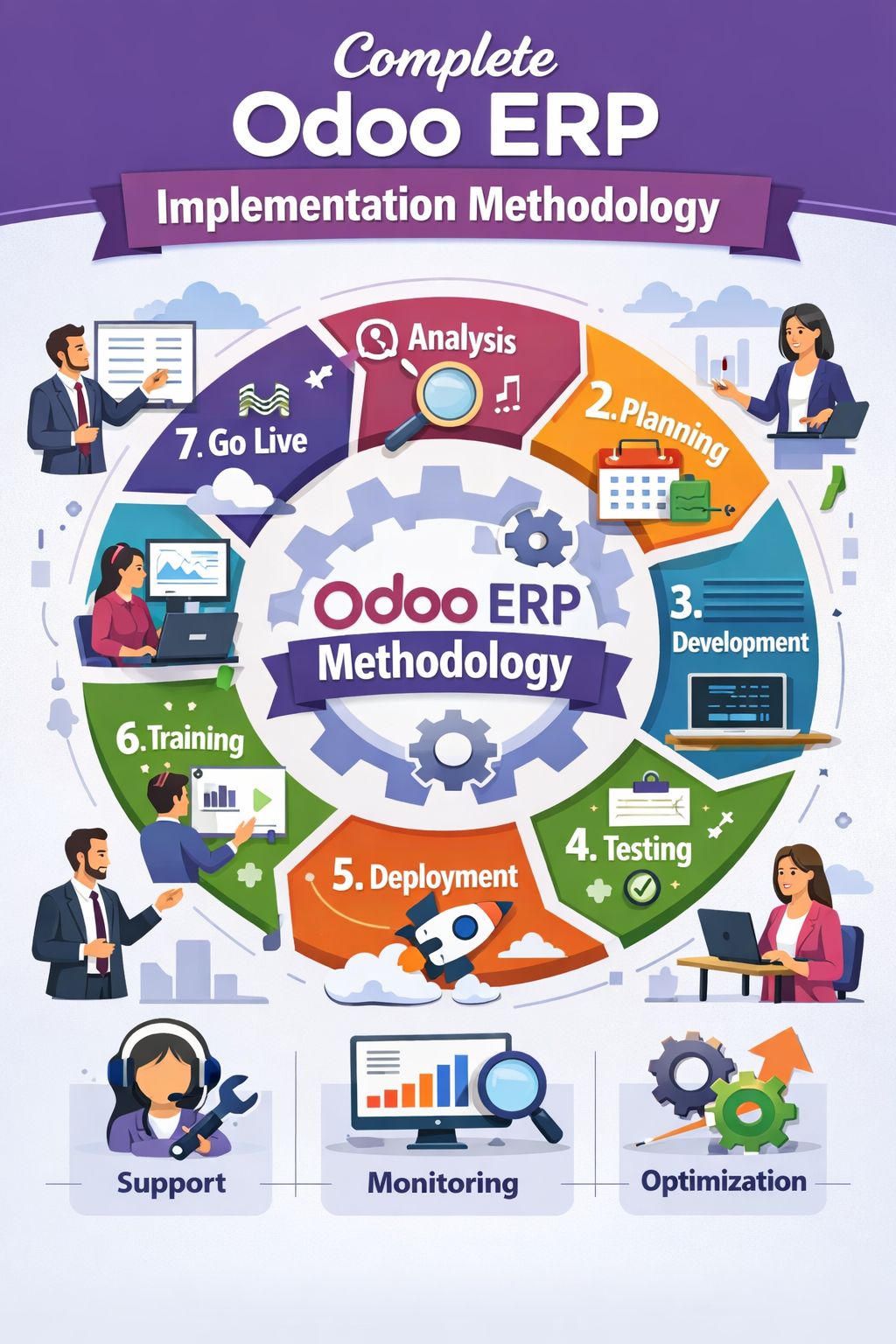
Phase 5: Testing and quality checks
Before Odoo goes live, it needs thorough testing to make sure everything behaves the way it should. Finding a problem during testing is cheap. Finding the same problem after launch is expensive.
Types of testing
- Functional testing checks that each module and workflow works correctly.
- Integration testing confirms that connected systems talk to each other properly.
- User acceptance testing lets real users approve the workflows before launch.
- Performance testing checks how the system behaves under the workload you expect.
Good testing protects your business from disruption once the system is live, and it gives your team confidence going into launch day.
Phase 6: Training and change management
Even the best ERP system fails if people do not use it. This phase is often underestimated, and it is one of the biggest factors in whether a project succeeds.
Why change management matters
Employees resist new systems for very understandable reasons. They may not understand why things are changing, they may worry about disrupting the way they work, or they may dread learning yet another tool on top of a full workload. Handling these concerns openly, and early, makes a big difference.
A practical training plan
Training works best when it comes in several formats. Sessions designed for each role, short training videos, clear written guides, and workshops for individual departments all help different people learn in the way that suits them best.
Phase 7: Go live and deployment
This is the moment the system moves into real, everyday use.
Final preparations
Before launch, the team confirms the data is correct, checks that backups are working, and gets the support team ready to answer questions from users on the very first day.
Deployment options
- Big bang deployment means every module goes live at the same time.
- Phased rollout means modules go live one at a time.
- Hybrid approach means a mix of both, with some modules launched together and others added in stages.
The right choice depends on the size of your company, how complex your processes are, and how much risk you are comfortable taking on.
Phase 8: Support and optimization after launch
Going live is not the end of the journey. It is the beginning of getting real value from the system.
What ongoing support includes
Bug fixes, security updates, compliance changes, and regular improvements keep the system running well long after launch. Businesses that plan for this from the start avoid the slow decline that hits systems nobody looks after.
Optimizing the system
Modern ERP systems increasingly include smart tools and analytics, along with better reporting, more automated processes, and live dashboards. Businesses that keep improving their setup usually get far more value from Odoo as time goes on.
8 common Odoo implementation mistakes to avoid
Odoo is flexible and modular, but a poorly managed project can still blow the budget, miss deadlines, and struggle with adoption. Knowing the common mistakes in advance is the easiest way to avoid them.
1. Unclear business requirements
Some businesses skip proper discovery. They do not map their processes, find their gaps, or define their long term goals. The result is a system that does not match how the business really works, along with delays and a lot of rework.
2. Too much customization
Odoo makes customization easy, which tempts many businesses to overdo it. This adds complexity, raises maintenance costs, makes upgrades harder, and stretches the project timeline far beyond the original plan.
3. Poor data migration
Bad migration leads to wrong data, weak reporting, and broken automation. It can also cause stock errors, incomplete financial records, and plenty of duplicate entries that take months to clean up.
4. Low adoption
When teams are not trained well, or their routines are disrupted without support, they avoid the new system and go back to old habits. Lack of training and unfamiliarity with the tool are the biggest causes.
5. Integration problems
Odoo often needs to connect to online stores, payment systems, CRMs, and shipping tools. Weak planning here breaks automation and creates syncing problems that frustrate users.
6. Unrealistic estimates
Underestimating the time needed for customization, migration, testing, and training pushes teams to rush the launch. Rushed launches almost always disrupt the business.
7. Not enough testing
Weak testing leads to broken workflows, poor reports, wrong stock counts, and failing integrations that only show up once real customers are affected.
8. No support after launch
An ERP system is never really finished. Businesses need ongoing help with improvements, new features, and daily support long after the project team has left.
Why the right Odoo implementation partner matters
Installing Odoo is not like installing a normal app. It changes how your business operates day to day. The partner you pick has a big effect on the outcome, and on the return you get from your investment. Here is what a strong partner brings to the table.
1. A real understanding of your business
A good partner takes the time to learn your workflows, your challenges, and your industry, along with your plans for growth. That understanding leads to a system built around your processes, not just a pile of settings that happen to work.
2. Fewer surprises during the project
ERP projects come with real challenges, like moving old data and mapping business processes to new workflows. An experienced partner plans for these from day one and works to prevent:
- Delays in the schedule
- Going over budget
- Disruption to daily work
- Mistakes during go live
3. Customization that supports growth
The right partner makes sure any customization can scale, that connecting other software later will be easy, and that the system can keep growing along with your business.
4. More value from your investment
Experienced partners set up Odoo faster through proven methods and smart automation. That means less downtime, better efficiency, and a stronger return on what you spend.
5. Better adoption by your team
People make or break an ERP project. A good partner provides training, change management, and user support during and after go live, so your team actually uses the system with confidence.
6. Long term support
The relationship should not end at launch. Your business will keep needing:
- Support to keep performance strong
- Steady improvements to processes
- Ongoing technical help
- New features and enhancements
Why choose Accountrix Solutions for your Odoo implementation
The partner you choose shapes how your ERP performs for years to come. Accountrix Solutions combines Odoo expertise with a team of qualified accountants, so your system is set up with both technology and finance in mind. Here is what sets us apart.
1. Official Odoo partner with proven experience
We are an official Odoo partner with a skilled team that has experience delivering custom, scalable Odoo systems. We focus on your success and on improving the way your business runs day to day.
2. Finance knowledge built in
Our team includes certified accounting professionals, which means your Odoo accounting setup is done properly from the start. We also offer ongoing Odoo bookkeeping for businesses that want help keeping their books accurate after go live.
3. A clear, structured process
We follow the phases described in this guide, so you always know what is happening and what comes next. That keeps projects on time, reduces delays, and cuts down on problems after launch.
4. Experience across industries
We work with businesses in manufacturing, retail, healthcare, finance, education, and logistics, so we understand the operational and compliance needs that come with each of them.
5. Every Odoo service in one place
We cover the whole journey, including:
- Consulting
- Implementation
- Customization and module development
- Third party integrations
- Data migration
- Support and maintenance after launch
That means one partner for all your ERP needs.
6. Support that grows with you
Implementation is not a one time project. Our ongoing support helps you:
- Manage business growth
- Improve your processes
- Keep improving your ERP
- Increase automation
- Scale as you grow
This long term approach helps you get the most out of Odoo for years.
Conclusion
Odoo is more than software. When it is implemented with a clear methodology, it becomes a connected system that helps a business run smoother, make better decisions, and grow with confidence. A strong process, a realistic plan, and the right partner make the difference between an ERP project that struggles and one that delivers real results.
At Accountrix Solutions, we help businesses simplify their ERP journey and avoid the common problems that slow projects down. We are an official Odoo partner, ready to guide you from the first conversation to long term success.
Ready to implement Odoo ERP?
Talk to our team and see how a well planned Odoo implementation can modernize your operations and support your growth. Get in touch with Accountrix Solutions today to start the conversation.
Recent Posts

October 14, 2026
Bookkeeping vs Accounting: Which Does Your Business Need?


October 13, 2026
Leave a comment