
By Accountrix Solutions · Updated November 2026
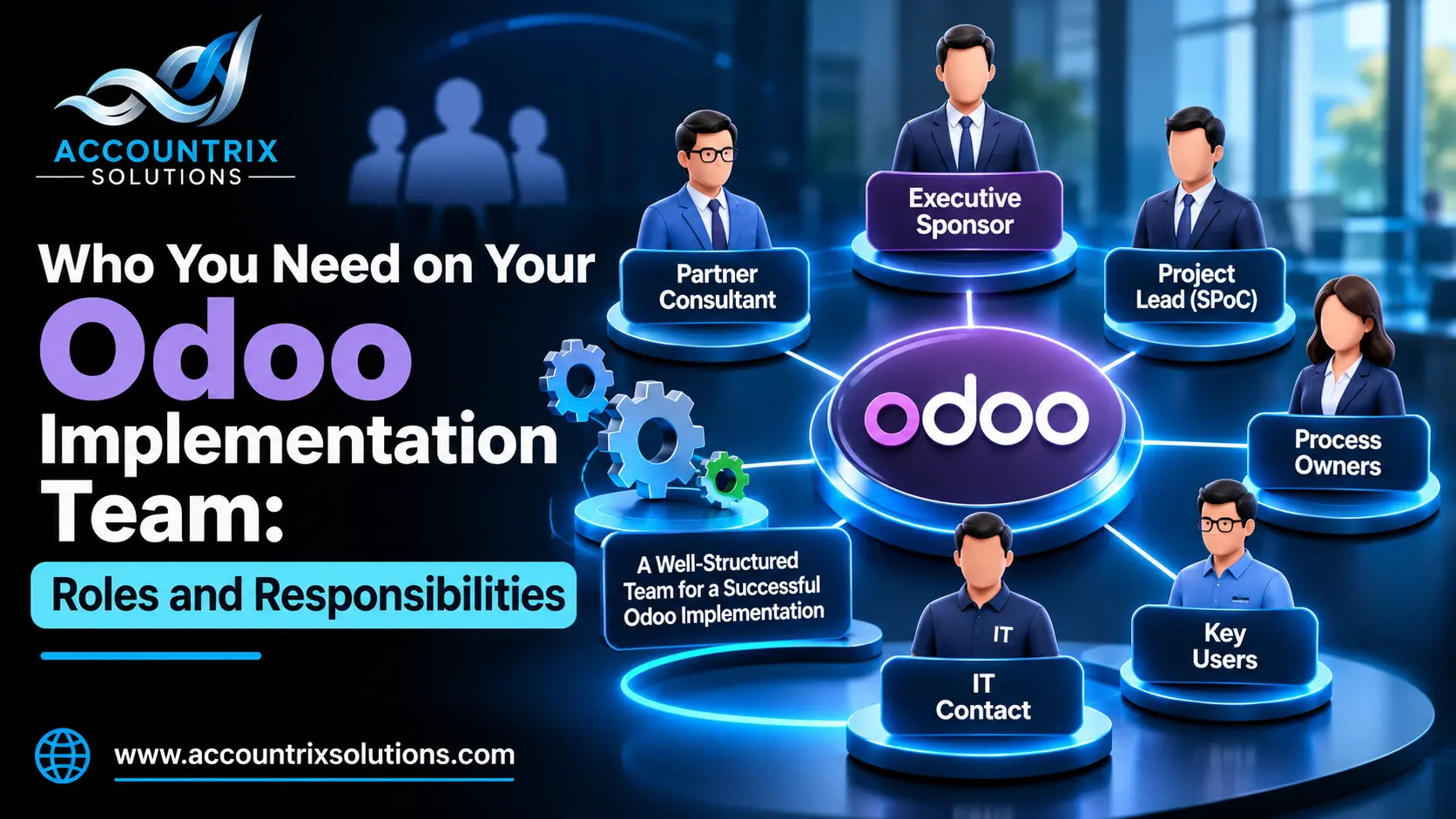
Your Odoo implementation team needs six roles: an executive sponsor, a project lead, process owners for each area such as sales, inventory and finance, key users, an IT contact and, from your partner, a consultant who leads the project. In a small company one person can hold more than one role, but every role needs a named owner. Odoo’s own implementation methodology calls the project lead on your side the Single Point of Contact (SPoC), and the project manager on the partner side the Project Leader. This guide explains what each role does, how much time it takes, and the mistakes to avoid, such as leaving everything to IT.
- Six roles make up the team: sponsor, project lead, process owners, key users, IT contact and partner consultant.
- The project lead on your side is the one decision maker, and carries the heaviest load.
- Process owners decide how work should run. IT supports them, and does not decide for them.
- Key users test and train, so they need real time, not leftover time.
- Small teams can combine roles, but three jobs must be covered: decide, know the process and test.
What an Odoo implementation team is, and who sits on it
An Odoo implementation team is the group of people from your company and your Odoo partner who plan, set up, test and launch Odoo together. Two sides share the work. Your side knows the business. The partner’s side knows the software. Odoo’s methodology names roles on both sides, and guides built on it add the sponsor, process owners and key users on yours:
In larger projects, guides built on Odoo’s methodology also describe a steering committee: the key leaders of the company and the partner, who make strategic decisions. A small business does not need a formal committee, but it does need someone who plays that part.
Who is the Odoo project manager?
People who search for an Odoo project manager usually mean one of two people, and both exist on a real project. The partner side has a project manager, which Odoo calls the Project Leader. Your side has a project lead who makes the business decisions, which Odoo calls the Single Point of Contact. They talk every week, and a project goes well when both are named early. This guide is about the people who run the implementation, not the Project app inside Odoo.
Odoo implementation team roles and what each one does
Every role below follows the same pattern: what they do, who should do it, how heavy the load is, and the mistake to avoid.
Executive sponsor
Fund the project, set priorities, remove blockers and settle disputes between departments. Guides built on Odoo’s methodology describe the sponsor as typically a C-level executive who funds the project.
The owner, CEO or CFO.
Short, regular check-ins, plus quick answers when a decision is stuck.
Signing the budget and then disappearing. Visible support matters.
Project lead (SPoC)
Act as the one decision maker on your side. Odoo’s documentation says the SPoC passes business knowledge to the partner, coordinates the key users and keeps the implementation consistent from a business point of view.
Someone who knows the business, is trusted, and can say yes or no without asking three people.
The heaviest load on your team, at every phase.
Naming a person with no authority, or with no cover for their daily job.
Process owners
Own how a process works, for example sales, inventory or finance. They explain it, approve how Odoo handles it, and settle exceptions.
The head of each area, or the person who decides how that area works.
Heavy in discovery and testing, lighter in between.
Sending a junior colleague who cannot decide anything.
Key users
Subject matter experts from each department. They define detailed requirements, run real examples in user acceptance testing (UAT), and later train their colleagues.
The people who do the work every day, such as the person who enters orders or reconciles the bank.
Heaviest during testing and training.
Picking whoever has the least to do. The busiest experts are the right ones, with cover.
IT contact
Handle access, user accounts, security, hosting questions, devices, email and technical connections with your other tools.
Your IT person or managed IT provider.
Spikes at setup, data load and go-live.
Leaving everything to IT. IT can set up accounts, but it cannot decide how sales or finance should work.
Partner consultant
Lead the project from the partner side. Odoo’s methodology describes this Project Leader as a mix of project manager, business analyst and product expert. They compare your processes with standard Odoo, configure the system, train key users and manage the plan and the risks.
An experienced person from your Odoo partner, with a named backup.
Carried by the partner.
Treating them as a vendor who will guess. They need decisions from your lead every week. If you want the consultant role and the whole project handled by a partner, our Odoo implementation services team covers it.
How much time does each role need on an Odoo implementation?
Time is where projects fail quietly. The table shows the shape of the load across a project. More squares mean more of that person’s week. Real hours depend on your project, so ask your partner for numbers before you start.
| Role | Discovery | Setup | Data load | Testing | Training | Go-live |
|---|---|---|---|---|---|---|
| Executive sponsor | ||||||
| Project lead | ||||||
| Process owners | ||||||
| Key users | ||||||
| IT contact |
Three habits protect that time:
- Put the project time into calendars before kickoff, and treat it like a client meeting.
- Arrange cover for each person’s daily work, so testing does not happen after hours.
- Check holidays and busy seasons against the plan for the whole project.
Who decides what? A simple RACI chart for your Odoo team
A RACI chart shows who is responsible for each task, and who has the final say. It stops the same question from bouncing between five people. Use it as a starting point and adjust it to your company.
| Task | Sponsor | Project lead | Process owner | Key users | IT contact | Consultant |
|---|---|---|---|---|---|---|
| Approve scope and budget | A | R | C | I | I | C |
| Describe how each process works today | I | C | A | R | I | C |
| Decide how Odoo will handle each process | I | A | R | C | I | R |
| Clean and check the data | I | A | R | R | C | C |
| Configure Odoo | I | A | C | I | C | R |
| Test with real cases (UAT) | I | A | C | R | C | R |
| Train the users | I | A | C | R | I | R |
| Set up access, security and hosting | I | C | I | I | A | R |
| Decide to go live | A | R | C | C | C | C |
How the Odoo implementation team works week to week
Odoo’s documentation says that a clear split of roles and a clear description of how the team works, including how things are validated and how problems are solved, are crucial. A simple rhythm covers it:
- One weekly meeting between your project lead and the partner’s consultant, with a fixed agenda.
- One shared list of open questions, with a name and a date next to each one.
- A decision log, so nobody reopens a choice that was already made.
- A short sponsor check-in every few weeks, to settle blockers.
- Demos and test sessions with key users, on a copy that holds your real data.
- One channel for requests: everything goes through the project lead, not through five different people.
Mistakes that sink an Odoo implementation team
Why it hurts: IT cannot decide how sales, stock or finance should work.
Instead: a business leader owns the project, and IT is one role.
Why it hurts: every question goes to a committee, and decisions slow down.
Instead: name one project lead with real authority.
Why it hurts: departments argue and nobody settles it.
Instead: a fixed sponsor check-in, and fast answers.
Why it hurts: testing happens late, and problems appear after go-live.
Instead: protected hours and cover for daily work.
Why it hurts: the project becomes everyone’s second priority.
Instead: free a real block of the lead’s week.
Why it hurts: considering everyone’s wish makes decisions slow and costly.
Instead: a small core team, and others consulted through their process owner.
Small company? How to combine the roles
A ten-person business cannot staff six separate roles, and it does not need to. What it needs is that every role has a name next to it. Here is how combining usually works:
| Company size | Typical setup | Watch for |
|---|---|---|
| Very small | The owner is the sponsor and the project lead. An office manager is the finance owner and a key user. | The owner’s time. Arrange cover for daily work. |
| Small | The owner is the sponsor. A manager is the project lead. Heads of sales, stock and finance are process owners. | Process owners who are also the only key users. |
| Growing | All six roles filled, plus a steering group that meets every few weeks. | Too many people in meetings. |
Whatever your size, make sure three jobs are covered: someone who decides, someone who knows the process, and someone who tests.
How to choose the people for your Odoo implementation team
Before you write names next to the roles, check each person against this list:
- They know how the work really runs, including the exceptions.
- They can decide, or they know who can, fast.
- Colleagues trust them, so training is easier later.
- They have real time, or they will get cover.
- They explain things clearly and ask when they do not know.
Your first week: a kickoff checklist
- Write a name next to every role, including backups.
- Book the project hours in everyone’s calendar.
- Agree the meeting rhythm and who attends.
- Set the rule for decisions: who decides, and how fast.
- Start the open-questions list and the decision log.
- Agree how problems reach the sponsor.
Frequently asked questions
Who should be on an Odoo implementation team?
An executive sponsor, a project lead, process owners for each area such as sales, inventory and finance, key users, an IT contact and a consultant from your partner. In a small company one person can hold several roles, but every role needs a named owner.
Who is the project manager in an Odoo implementation?
There are two. The partner side has a project manager, which Odoo’s methodology calls the Project Leader. Your side has a project lead who makes business decisions, called the Single Point of Contact. They work together every week.
What is the SPoC in an Odoo implementation?
SPoC stands for Single Point of Contact. It is the one decision maker on the client side. The SPoC passes business knowledge to the partner, coordinates the key users and keeps the implementation consistent from a business point of view.
How much time does the project lead need?
The project lead carries the heaviest load on your team, at every phase. Plan a recurring weekly block, more time during testing, training and go-live, and cover for their daily work. Ask your partner for numbers for your project.
Should IT lead an Odoo implementation?
Not alone. IT supports access, security, hosting and technical questions. The business decides how sales, stock and finance work, so a business leader should own the project, with IT as one role.
Can one person hold several roles in a small business?
Yes. An owner can be sponsor and project lead, and an office manager can be the finance owner and a key user. The risk is time, so arrange cover, and make sure someone decides, someone knows the process and someone tests.
What does the partner’s consultant do on an Odoo project?
The consultant leads the project from the partner side. They compare your processes with standard Odoo, configure the system, manage the plan and risks, train key users and act as your main contact. Odoo’s methodology describes the role as a mix of project manager, business analyst and product expert.
Final thoughts
A strong Odoo implementation team is not a big one. It is a team where every role has a name, the project lead can decide, IT supports and does not own the process, key users have time to test, and the partner’s consultant gets answers every week. Fill the roles first, protect the time second, and the software becomes the easy part.
If you want a second opinion on who should be on your team, or help running the whole project, ask the team at Accountrix Solutions.



Leave a comment