
Cash Flow vs Profit: Why a Profitable Business Can Still Run Out of Cash
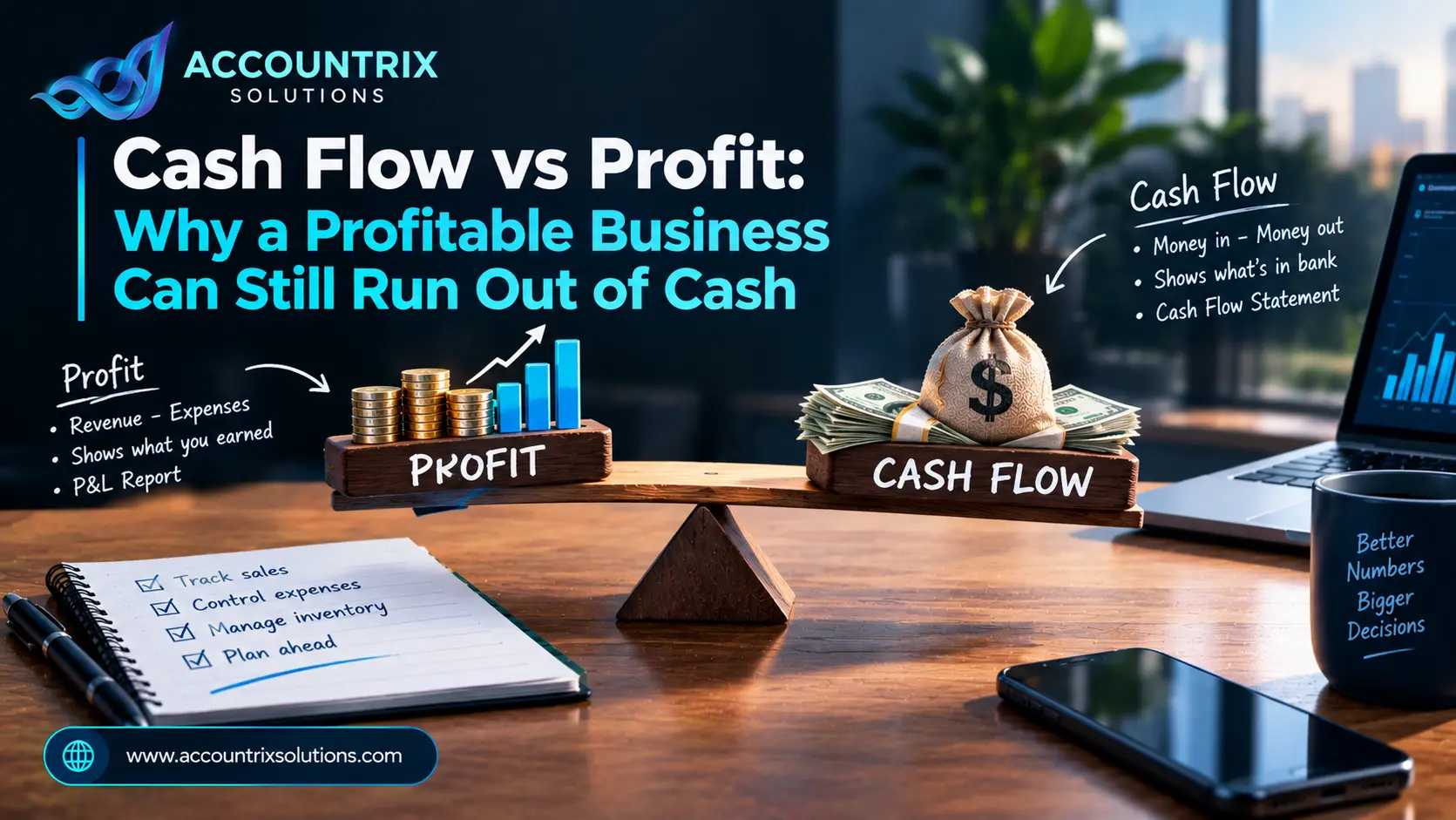
Cash flow and profit measure two different things, and the gap between them is why a profitable business can still run out of cash. Profit is what your business earned after costs, counted when you make the sale or take on the cost. Cash flow is the money that actually moves in and out of your bank account. Cash flow vs profit is mostly a question of timing: customers pay late, stock sits on shelves, and loan repayments, taxes and owner draws take cash without ever showing up as an expense. This guide explains the gap, walks through a worked example, and gives you a weekly routine that keeps cash safe.
Cash flow vs profit: the plain-English difference
Both numbers matter, but they answer different questions. This is how they compare:
Profit
What it isRevenue minus expenses for a period. Counted whenThe sale is made or the cost is incurred. Where you see itThe profit and loss report. The question it answersIs my business making money?Cash flow
What it isCash in minus cash out for a period. Counted whenMoney lands in or leaves your bank account. Where you see itThe cash flow statement and your bank balance. The question it answersCan I pay my bills this week?The SEC beginners’ guide to financial statements describes the cash flow statement as a record of money moving between a company and the outside world over a period of time. That is a different job from the income statement, which reports profit.
The three parts of a cash flow statement
- Operating: money from customers, minus money paid for stock, wages, rent and other running costs.
- Investing: money spent on or received from equipment, property and other long-term assets.
- Financing: loans taken and repaid, and money the owners put in or take out.
Most owners should look at operating cash flow first. It shows whether the day-to-day business pays for itself.
Seven reasons a profitable business runs out of cash
You count the sale as profit the day you send the invoice. The cash arrives 30, 60 or even 90 days later, but payroll and rent are due now. Unpaid invoices are called accounts receivable, and they are profit you cannot spend yet. Accounting software can list them by age. In QuickBooks that is the A/R aging report, and our QuickBooks bookkeeping services team can build it into your monthly review.
Inventory is not an expense until you sell it. Until then, it is cash sitting on a shelf. A big batch bought at a good price can empty your bank account without changing your profit at all.
If suppliers want payment in 15 days and customers take 60, you fund the 45-day gap from your own bank account. Owners call that gap a working capital problem.
Only the interest on a loan reduces profit. The part of each instalment that repays the loan itself leaves your bank account without appearing on the profit and loss report.
A vehicle or machine is recorded as an asset, and its cost is spread over several years as depreciation. The cash leaves in one go.
Income tax is paid on a schedule, often in quarterly instalments for sole proprietors and partners. Money you take out as an owner is not an expense either. Both reduce your bank balance and leave profit alone.
A bigger order needs more stock, more staff and more spending before the customer pays. Fast growth drains cash faster than slow growth, which is why growing businesses are often the ones that get caught.
Cash method vs accrual method: why your reports can mislead you
How your books count income decides which story the profit report tells. Under the cash method, you generally report income when you receive it and deduct expenses when you pay them. Under the accrual method, you generally report income when you earn it, no matter when payment arrives, as IRS Pub 538 explains.
Accrual reports give a truer picture of earnings, but they hide the waiting time. A business on accrual can show a big profit while the bank balance falls. On the cash method, profit and cash sit closer together, but loans, stock, equipment and owner draws still pull them apart.
Where each event shows up
| What happens | Profit report (accrual) | Bank balance |
|---|---|---|
| You send a $5,000 invoice | Up $5,000 | No change until it is paid |
| The customer pays that invoice | No change | Up $5,000 |
| You buy $3,000 of stock | No change until it sells | Down $3,000 |
| You pay a $1,000 loan instalment ($900 repays the loan, $100 is interest) | Down $100 | Down $1,000 |
| You buy a $12,000 machine | Down a small slice each year | Down $12,000 |
| You take a $2,000 owner draw | No change | Down $2,000 |
A worked example: $42,000 of profit and a negative bank balance
These numbers are made up, but the pattern is real. A small agency starts with $30,000 in the bank. It pays its costs in the month they happen, and customers pay after 60 days. Sales grow every month. Cash received in the first two months comes from older, smaller sales.
| Month | Sales invoiced | Costs paid | Profit | Cash received | Cash change | Bank balance |
|---|---|---|---|---|---|---|
| 1 | 40,000 | 30,000 | 10,000 | 20,000 | −10,000 | 20,000 |
| 2 | 55,000 | 41,000 | 14,000 | 25,000 | −16,000 | 4,000 |
| 3 | 70,000 | 52,000 | 18,000 | 40,000 | −12,000 | −8,000 |
| Total | 165,000 | 123,000 | 42,000 | 85,000 | −38,000 | −8,000 |
The profit report says the agency earned $42,000. The bank says it is $8,000 overdrawn.
Nothing is wrong with the sales. Customers will pay, just not in time. Growth made it worse, because each month’s bigger sales added costs now and waiting later. Notice too that the warning was there in month one, when cash fell by $10,000 while the profit report showed a gain. An owner who checked cash change every month would have seen it coming.
Warning signs, and the reports that show them
Watch for these signs. Any one of them is a reason to look at your cash, not just your profit:
Four reports worth reading
- Cash flow statement. Shows operating, investing and financing movements for the period.
- Aged receivables. Lists who owes you money and for how long.
- Aged payables. Lists what you owe and when it is due.
- A rolling cash forecast. A week-by-week list of expected money in and out for the next 12 to 13 weeks, updated every week.
All four depend on current books. If invoices and bank lines are two months behind, the reports are guesses. In Odoo, the aged receivable and payable reports sit in the accounting app beside the profit and loss report, and our Odoo bookkeeping team can set them up and keep them current.
How to close the gap: seven levers
| Lever | What to do | Why it helps |
|---|---|---|
| Invoice faster | Send the invoice on the day of delivery. Ask for deposits or milestone payments on bigger jobs. | The payment clock starts earlier |
| Enforce your terms | Move from 60 days to 30 where you can. Send a reminder before the due date and another right after. | Cuts the waiting time |
| Make paying easy | Add card and bank transfer options and a payment link on every invoice. | Removes excuses for delay |
| Negotiate supplier terms | Ask for longer terms, and pay on the due date, not early. | Stretches the gap in your favor |
| Buy stock in smaller batches | Reorder more often in smaller lots where the discount allows. | Less cash sits on shelves |
| Set tax money aside weekly | Move a fixed share of income into a separate account. | The tax bill is already funded |
| Build a cash cushion | Aim for a reserve that covers your fixed costs for a few months. | Absorbs late payments and slow weeks |
Software can do part of this work. Zoho Books, for example, can send payment reminders and add online payment options to invoices, and our Zoho bookkeeping services team can set that up for you. Short-term borrowing can bridge a timing gap, but it costs money and does not fix the cause.
A weekly cash routine that takes 30 minutes
Profit deserves a monthly look. Cash deserves a weekly one. Pick the same day each week and do this:
Check balances. Open every bank account and card.
Review unpaid invoices. List the ones past due and decide who to call today.
List bills due. Cover the next two weeks, including payroll, tax and loan payments.
Update the forecast. Add what happened and extend it by one week.
Find the low point. Note the lowest balance you expect in the next eight weeks.
Decide early. Chase, delay, trim or borrow, before the gap arrives.
Once a month, compare profit with the change in cash. If you can explain the difference line by line, you understand your business.
Can a business have positive cash flow and still lose money?
Yes. Cash can rise for reasons that are not earnings: a loan, an owner putting in money, customers paying in advance, or the sale of equipment. Meanwhile, non-cash items such as depreciation lower profit without moving cash. A business can look healthy in the bank while losing money on its sales, until the borrowed money runs out. Check operating cash flow, the money that comes from running the business, to see whether the business pays for itself.
When to ask a bookkeeper for help
These numbers only help when the books are current. Look for help if invoices and bills are entered weeks late, bank accounts are not reconciled, you cannot pull an aged receivables report, or profit and bank balance disagree and nobody can explain why. A bookkeeper keeps the reports accurate, so a cash problem shows up as a number early, not as a bounced payment. If you want to know where your own business stands, talk to our team and we will tell you honestly what your books show.
Frequently asked questions
Can a profitable business run out of cash?
Yes. Profit counts a sale when it is made, but cash only arrives when the customer pays. Late payments, stock purchases, loan repayments, tax payments and owner draws can drain the bank account while the profit and loss report looks healthy.
What is the difference between cash flow and profit?
Profit is revenue minus expenses, counted when sales are made and costs are incurred. Cash flow is the money that actually moves in and out of your bank account. They differ because of timing, and because some payments, such as loan principal, are not expenses.
Why is my bank balance lower than my profit?
Common reasons are unpaid customer invoices, money spent on stock, loan principal repayments, equipment purchases, tax payments and owner draws. None of these reduce profit right away, but all of them reduce cash.
Which is more important, cash flow or profit?
Both. Cash flow decides whether you can pay bills this week. Profit decides whether the business is worth running over time. Profit without cash flow is fragile, and cash flow without profit is only borrowing time.
What is a cash flow statement?
It shows how money moved into and out of a business over a period, in three parts: operating, investing and financing activities.
How can I improve cash flow quickly?
Invoice on the day of delivery, send reminders before the due date, add easy payment options, ask suppliers for longer terms, buy stock in smaller batches and set tax money aside every week.
How often should I check my cash flow?
Check cash every week and review profit every month. A weekly look at balances, unpaid invoices and upcoming bills catches problems early.
Final thoughts
Profit tells you whether the business is worth running. Cash tells you whether it will still be running next month. You need both numbers, read at different speeds: cash every week, profit every month. Keep your books current, watch the aged receivables, forecast a few weeks ahead, and the gap between the two stops being a surprise.
Profit looks fine, but the bank balance does not? Tell us what you see and we will help you find where the cash is going.
Tell us where your cash is going



Leave a comment