
-
November 20, 2026
-
8 Views
FBR vs PRA vs SRB: Which E-Invoicing System Does Your Business Actually Need?
SHORT ANSWER
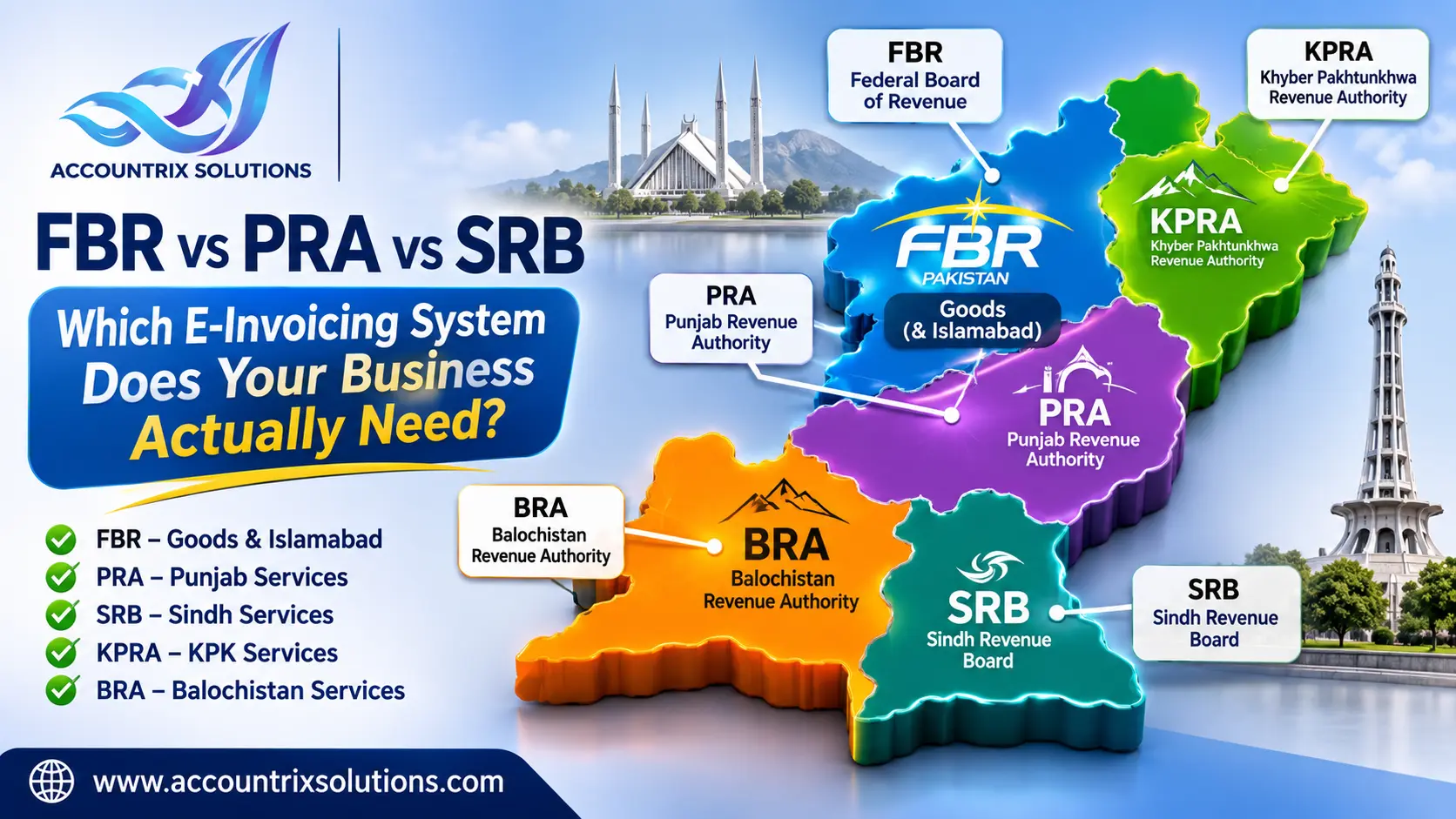
FBR vs PRA vs SRB comes down to what you sell and where you sell it. FBR runs e-invoicing for goods and for services in Islamabad. The provincial authorities (PRA in Punjab, SRB in Sindh, KPRA in Khyber Pakhtunkhwa and BRA in Balochistan) run their own systems for services. If you sell both goods and services, you may have to deal with two of them.
If you searched for FBR vs PRA vs SRB, you probably want a straight answer, not a legal lecture. This guide gives you one. We checked FBR's own rule booklet and the provincial updates, and we only state what those sources support. Where the rules are still changing, we say so.
FBR vs PRA vs SRB: what is the difference, and where do KPRA and BRA fit?
All five collect sales tax. The split is about what is being taxed. FBR is the federal body, and it handles sales tax on goods. The provincial revenue authorities handle sales tax on services inside their province. Each one has its own portal, its own rules and its own invoice monitoring system.
| Authority | Covers | Invoice system you may meet |
|---|---|---|
| FBR | Goods across Pakistan, and services in Islamabad | Digital invoicing under the Sales Tax Rules, linked through PRAL or a licensed integrator |
| PRA (Punjab) | Services in Punjab | Electronic Invoice Monitoring System, called EIMS |
| SRB (Sindh) | Services in Sindh | Online integration under the Sindh Sales Tax Special Procedure (Online Integration of Business) Rules, 2022 |
| KPRA (Khyber Pakhtunkhwa) | Services in KP | Check KPRA directly for the current requirement for your sector |
| BRA (Balochistan) | Services in Balochistan | Balochistan Sales Tax Special Procedure (Online Integration of Business) Rules |
Why does Pakistan have more than one e-invoicing system?
Because the tax itself is split. Goods are taxed under the federal Sales Tax Act, 1990. Services are taxed by the provinces. Sindh passed its own Sales Tax on Services Act in 2011, and the other provinces built their own authorities too. So every authority wants to see your invoices for the tax it collects.
Federal side FBR collects sales tax on goods. Its digital invoicing system sends every invoice to FBR and returns a unique FBR invoice number. | Provincial side PRA, SRB, KPRA and BRA collect sales tax on services. Each one monitors invoices for its own province. |
There is one more layer. FBR also asks some service businesses to integrate for income tax reasons under Chapter VII-A of the Income Tax Rules, 2002. This is where the overlap starts, and we cover it below.
When does a business need FBR digital invoicing?
You need it when FBR has notified you. The Sales Tax Rules, 2006 say the rules apply to registered persons that the Board notifies in the official Gazette. Once notified, you must register, install and connect your invoicing software or POS with FBR's system. You can read the full text in the FBR rules booklet.
Who is clearly covered?
- Tier-1 retailers. The Act lists them: outlets of national or international chains, shops in air-conditioned malls, retailers with a very high electricity bill, wholesaler-cum-retailers, and retailers who accept card payments through a bank POS.
- Other notified registered persons. FBR can notify any class of sales tax registered person.
- Online sellers. The rules say online sale and online marketplace websites, software and apps must be registered with FBR's system too.
What must an FBR-integrated invoice do?
- Reach FBR in real time and receive a unique FBR invoice number.
- Carry a QR code printed on the receipt.
- Show the seller and buyer details, tax rate, tax amount, HS code and unit of measurement.
- Be marked as offline if the internet or power fails, and be uploaded within 24 hours of restoration.
- Be kept as an electronic record for six years.
The cost of hardware and software is yours. PRAL, which acts as a licensed integrator, provides integration free of cost on demand. Private integrators can also do the job, but only if FBR has licensed them. An unlicensed vendor cannot legally integrate you.
The penalty is not small. For a Tier-1 retailer who fails to integrate, the first default carries a penalty of five hundred thousand rupees, and the amount rises with each default. Business premises can also be sealed. That is why a clear setup matters. Our FBR e-invoicing setup page explains how we handle the connection for Pakistani businesses.
When do you need PRA, SRB, KPRA or BRA instead?
You need a provincial system when your business sells taxable services in that province and the authority has notified your sector. Here is what we could confirm for each one.
| 01 | PRA in Punjab PRA issued a notification making EIMS mandatory for hotels, restaurants, coffee shops and marriage halls. Daily Pakistan reported fines from Rs400,000 to Rs1 million for failing to issue receipts through EIMS, and sealing for repeat offenders. TechJuice reported that PRA is pushing installation across 14 designated sectors. |
| 02 | SRB in Sindh SRB runs integration under its 2022 special procedure rules. Customs Today reported a July 2025 amendment that pushed restaurants meeting set criteria, such as multiple branches, mall locations or high turnover, toward integration. |
| 03 | BRA in Balochistan BRA has its own Online Integration of Business Rules. Business Recorder reported that BRA wrote to FBR about overlap for services already covered by its rules. |
| 04 | KPRA in Khyber Pakhtunkhwa We did not find a clear public notice we can safely summarise. Check the KPRA website or ask your tax advisor before you act. |
What if your business falls under both FBR and a province?
This is the real headache. A shop that sells goods and also runs a cafe counter, or a business that sells products and also charges for installation or repair, may touch both systems. In 2024, PRA said it planned to link EIMS with FBR's POS system so taxpayers would not integrate twice. Customs Today reported it as a phased plan, starting with restaurants. We could not confirm how far it has reached, so do not assume it is done.
The overlap also showed up in early 2026. FBR published draft SRO 288(I)/2026 on 18 February 2026. It proposes a new Chapter VII-A for service sectors such as restaurants, hotels, marriage halls, clubs, courier services, clinics and schools. Profit and Business Recorder reported that BRA and SRB asked FBR to wait, because several of these services already integrate with provincial systems. KPMG notes that a draft does not apply until FBR issues a final notification and a general order. We did not find a final version, so check FBR's SRO page before you rely on it.
If you are in this position, the practical answer is one billing system that can report to more than one authority. At Accountrix Solutions we build our digital invoicing service around that idea, so you do not run two separate tills for one sale.
Which e-invoicing system fits your business?
Use this as a starting point. Always confirm against your registration certificate and the latest notification.
| You sell goods through a mall shop, chain outlet or high-volume retail store | → | Look at FBR digital invoicing |
| You run a restaurant, cafe, hotel or marriage hall in Punjab | → | Look at PRA EIMS |
| You run the same kind of business in Sindh | → | Look at SRB integration |
| You sell goods online or run a marketplace | → | FBR rules cover your website or app |
| You offer professional or personal services in a province | → | Check your provincial authority first, then watch the FBR draft |
| You sell goods and services | → | Check both, and ask each authority in writing |
Does your POS or ERP need to change?
Often yes, or at least it needs an add-on. Under the FBR rules, the POS or invoicing software has to do more than print a receipt. It must create and store the invoice data, sign it, send it to FBR securely, and print the QR code from the FBR invoice number. It must also run a closing at the end of each day, week and month, log every adjustment or cancellation, and send alerts when it spots an error or misuse.
That list matters when you compare tools. A cheap till that only prints bills will not pass. Look for software that can handle FBR today and a provincial system tomorrow. Third-party connectors already exist for some platforms, for example an SRB POS connector listed for Odoo 18 on the Odoo Apps store. Treat any connector as a starting point: check the version, the vendor support and whether the authority accepts it.
How do you start without guessing?
| 01 | Find your registration Open your sales tax registration certificate. It shows whether you are registered with FBR, a provincial authority or both. |
| 02 | Check the notification Look for a notification that names your sector or retailer class. Being registered is not the same as being notified. |
| 03 | Pick a licensed route For FBR, use PRAL or a licensed integrator. For a province, use what that authority approves. |
| 04 | Test before going live FBR provides a test environment. Our guide to FBR sandbox testing scenarios shows what to run before you issue a real invoice. |
| 05 | Fix rejected invoices fast Every rejection comes with a code. Our list of FBR digital invoice error codes explains what each one means. |
| 06 | Keep records and signage Keep invoices for six years and show the "Integrated with FBR" signboard if you are an FBR integrated person. |
How can customers check that your invoice is real?
FBR must provide a verification facility on its website, so a buyer can confirm that an invoice reached FBR's system. For some integrated retailers, the Tax Asaan app and a WhatsApp number are also used to check an invoice and report one that shows as unverified. This is a good reason to print the QR code clearly and keep your system online. A buyer who cannot verify your invoice may report it, and an officer will look at it.
Officers can also visit your premises and check that invoices are reported in real time. If sales are made without an FBR invoice number, the officer can calculate the tax on those sales and recover it. So a missed invoice is not just a small error. It becomes a tax demand.
What mistakes do businesses make most often?
| MYTH Integrating with FBR also covers my provincial service tax. | FACT Not automatically. Each authority collects its own tax and monitors its own invoices. |
| MYTH Free PRAL integration means everything is free. | FACT PRAL integration is free of cost. Hardware and software costs are still borne by the business. |
| MYTH The FBR draft rules already apply to me. | FACT A draft binds nobody until FBR issues the final notification and the implementation order. |
| MYTH Any software vendor can connect me. | FACT FBR integration must go through PRAL or a licensed integrator. |
Frequently asked questions
Q. Is FBR e-invoicing the same as PRA EIMS?
No. They are separate systems run by different authorities. FBR covers goods and Islamabad services, while PRA covers services in Punjab.
Q. Which authority do I report to if I run a restaurant in Lahore?
PRA, because restaurants in Punjab fall under EIMS. Confirm it against your registration and the latest notification.
Q. Do I need to integrate with SRB if my head office is in Sindh but I sell in Punjab?
The tax follows where the service is provided. Ask both authorities in writing so you have a clear answer for each location.
Q. Can PRAL integrate me for free?
PRAL provides FBR integration free of cost on demand. You still pay for your own hardware and software.
Q. Is SRO 288(I)/2026 in force?
It was published as a draft on 18 February 2026. We found no final notification. Check FBR's website for the current status.
Final thoughts
Do not pick a system by name. Pick it by tax. Goods point to FBR, services point to the province, and mixed businesses need both answered. Because these rules change often, treat this article as a map, not legal advice, and confirm with your tax advisor or the authority itself before you act. We drew on FBR's POS booklet, SRO 69(I)/2025 coverage by EY, KPMG's tax alert, and reports from Business Recorder, Profit, Daily Pakistan, TechJuice and Customs Today.

Related Articles
Odoo Year-End Closing: Fiscal Year, Lock Dates and Opening Entries Explained
-
November 21, 2026
-
4 Views
FBR Digital Invoice Error Codes Explained: What Each API Error Means and How to Fix It
-
November 19, 2026
-
15 Views
FBR Digital Invoicing Sandbox Testing: All 28 Scenarios (SN001 to SN028) Explained
-
November 18, 2026
-
13 Views
Leave a comment