• Home
  • About Us
  • Services
    Odoo Implementation

    At Accountrix Solutions, we provide reliable Odoo implementation services that align Odoo...

    Odoo Customization

    we understand that every business follows different processes and faces unique...

    Odoo Integration

    Odoo is a free ERP system with various business apps to assist with different operational needs. Powerful...

    Odoo Migration

    Looking to upgrade or switch your Odoo ERP version without losing critical data...

    Digital invoicing

    Generate, dispatch, and monitor invoices promptly – designed for enterprises...

    Odoo Bookkeeping

    Managing your finances doesn’t have to be overwhelming. Our Odoo accounting and bookkeeping...

    Quickbooks Bookkeeping

    At Accountrix Solutions, we tailor our QuickBooks bookkeeping services around your unique...

    Zoho Bookkeeping

    Balancing your finances in Zoho Books alongside managing your business can be overwhelming. That is where...

  • Blog
  • Contact Us
LEt's talk

Bookkeeping vs Accounting: Which Does Your Business Need?

HomeBlogBookkeeping vs Accounting: Which Does Your Business Need?
Bookkeeping vs Accounting
  • October 14, 2026
  • Blog
  • 3 Views

Bookkeeping vs Accounting: Which Does Your Business Need?

The short answer

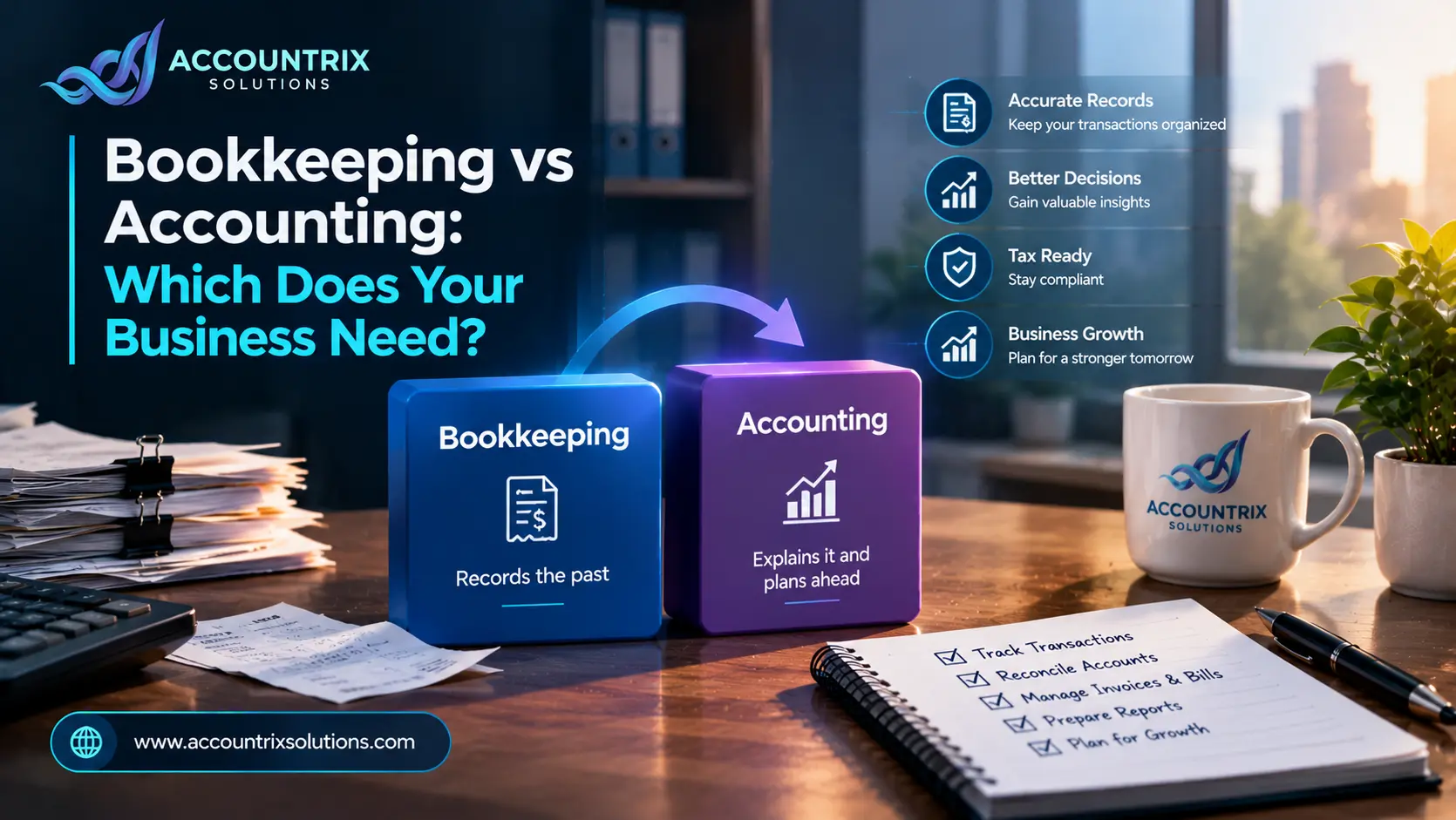
Bookkeeping records and organizes your financial transactions. Accounting interprets those records, prepares financial statements, plans your taxes and advises on decisions. Every business needs bookkeeping from day one. You add accounting when you need tax filing, analysis or advice, and most growing businesses end up needing both.

Bookkeeping
Records the past
“What happened to my money?”
Accounting
Explains it and plans ahead
“What does it mean, and what should I do next?”

Owners mix up these two words all the time, and it is easy to see why. Both deal with money, both use the same software, and many people who offer one also offer the other. But the bookkeeping vs accounting question matters, because hiring the wrong kind of help means either paying for skills you do not need yet or missing the ones you do.

This guide explains each one in plain language, shows which tasks belong where, and helps you decide what your business needs right now. It is written for US small business owners, and the same logic applies whether your books sit in QuickBooks, Zoho Books or Odoo.

What is bookkeeping?

Bookkeeping is the day-to-day work of recording and organizing your financial transactions. The U.S. Bureau of Labor Statistics describes the job as computing, classifying and recording data so an organization keeps complete and accurate financial records, covering both money spent and money received. You can read the full description on the BLS page for bookkeeping clerks.

In practice, a bookkeeper handles the routine that keeps your books true:

  • Recording every sale, expense and refund
  • Categorizing transactions so reports make sense
  • Reconciling bank and credit card accounts
  • Sending invoices and tracking bills, so you know who owes what
  • Entering payroll and contractor payments
  • Keeping receipts and documents organized

Two terms come up often here. Double-entry bookkeeping means every transaction is recorded in two accounts, one as a debit and one as a credit, so the books always balance and mistakes stand out. The other is your accounting basis. Under the cash basis you record income and expenses when money actually moves. Under the accrual basis you record them when they are earned or incurred. Your accountant usually helps you choose, and your bookkeeper then applies that choice consistently.

The output is a clean general ledger and accounts that match your bank. Nothing fancy, but everything else depends on it. The BLS notes that most bookkeepers learn on the job and work in specialized accounting software and spreadsheets, which is why good bookkeeping is as much about habit as it is about qualifications.

Many small businesses hand this routine to a bookkeeper who works directly inside their software. That is exactly what our QuickBooks bookkeeping services team does for businesses on QuickBooks.

What is accounting?

Accounting starts where bookkeeping ends. It takes the organized records and turns them into information you can act on. According to the BLS page for accountants and auditors, accountants prepare and examine financial records, check statements for accuracy and legal compliance, and combine financial information to guide business decisions.

Typical accounting work includes:

  • Preparing financial statements: profit and loss, balance sheet and cash flow
  • Tax planning and tax return preparation
  • Budgeting and forecasting
  • Analyzing margins, costs and trends
  • Supporting audits and compliance checks
  • Advising on decisions such as pricing, hiring, borrowing or buying equipment

Accounting also has branches. Financial accounting produces the statements that outsiders such as banks and investors read. Management accounting produces the numbers you use inside the business, like budgets and cost analysis. Tax accounting handles the rules for what you owe and when.

Accountants usually hold at least a bachelor's degree, and many become Certified Public Accountants, or CPAs, according to the BLS. That training is the main reason accountants cost more of your attention than bookkeepers. You are paying for judgment, not data entry.

Here is the simplest way to separate the two. Software, spreadsheets and habits can do much of bookkeeping. Accounting depends on interpretation, and interpretation needs a person who understands both the numbers and your business.

Bookkeeping vs accounting: how they fit together

They are not rivals. They are layers of the same stack, and each layer sits on the one below it.

Accounting
Advise and plan
Budgets, forecasts, tax strategy, decisions
Accounting
Report and analyze
Financial statements, margins, trends
Bookkeeping
Organize and reconcile
Categories, bank matches, open invoices and bills
Bookkeeping
Record transactions
Every sale, expense, payment and refund

If the base is cracked, everything above it is unreliable. An accountant who inherits messy records spends the first hours cleaning, not advising, and you pay for that time. This is why we always tell clients to fix the foundation first.

Software has moved the lower layers closer to automation. Bank feeds import transactions and rules categorize repeat items. But checking, reconciling and judging still need a person. Automation shrinks the work in the base layer. It does not remove the need for it.

In Odoo, both layers live in the same accounting app, so clean records at the base flow straight into the reports above them. Our Odoo bookkeeping team keeps that base layer healthy, so reports are ready when you or your accountant need them.

Who does which task?

Most owners find it easier to sort the work by task. Here is how a typical small business divides it.

Bookkeeping
Record transactions
Categorize expenses
Reconcile bank accounts
Send invoices, track bills
Enter payroll payments
File receipts
Both
Month-end close
Chart of accounts setup
Review monthly reports
Accounting
Financial statements
Tax planning and filing
Budgets and forecasts
Business advice
Audit support

The overlap sits at month-end. A bookkeeper closes the books and an accountant reviews what they show. If you run Zoho Books, our Zoho bookkeeping services team can take the left column off your plate, so your accountant starts from numbers that are already clean.

Key differences at a glance

Bookkeeping
Accounting
What happened?
Main question
What does it mean?
The past, recorded as it happens
Time focus
The past explained, and the future planned
Ledgers, reconciled accounts
Output
Financial statements, tax returns, advice
Accuracy, consistency, software
Skills
Analysis, tax knowledge, judgment
Daily or weekly, closed monthly
How often
Monthly, quarterly and yearly
You and your accountant
Who uses it
You, lenders, investors and tax authorities

One difference does not show up in the table: responsibility. A bookkeeper is accountable for accurate records. An accountant is accountable for the conclusions drawn from them. When something goes wrong, knowing which layer failed makes the fix much faster.

How bookkeeping and accounting work together every month

In a healthy setup, the two roles pass work to each other in a simple loop.

Record
The bookkeeper records and reconciles everything through month-end.
→
Close
The bookkeeper closes the month and shares the reports.
→
Review
The accountant reviews the numbers, flags issues and plans around them.
→
Decide
You act on clear numbers and send questions back into the loop.

When this loop runs every month, tax season turns into a formality. The accountant already knows your numbers, the bookkeeper already knows what the accountant needs, and you stop paying for rework.

What goes wrong when one layer is missing

Accounting without bookkeeping
The accountant starts from scattered records and spends their time on cleanup. You pay accountant rates for bookkeeper work, and the advice arrives late.
Bookkeeping without accounting
Your books are tidy, but nobody checks your tax position, margins or business structure. Problems show up after the fact.
Neither, just a spreadsheet
Numbers drift, receipts go missing and year-end becomes a reconstruction project.

Which does your business need?

The honest answer depends on how complicated your business is, not on how big it is. Find the stage that sounds most like yours.

1
You are just starting
Solo, few transactions
You need
Solid bookkeeping habits, plus an accountant for your yearly tax return
2
You are growing
Employees or contractors
You need
Regular bookkeeping, plus an accountant for payroll taxes and quarterly planning
3
You hold stock or run several companies
More moving parts
You need
Strong bookkeeping, an accountant, and a connected system so data is entered once
4
You plan to borrow, raise money or sell
Outsiders will read your numbers
You need
Both, with an accountant leading the statements and the review

These stages are not a one-way ladder. A seasonal business can sit at the first stage for months, then jump to the third the moment stock arrives. Review where you sit at least once a year, and again whenever you hire, add a product line or take on a loan.

If your business is at the third stage, the real fix is often a system that keeps stock, sales and finance together. That is the kind of setup our Odoo implementation services are built for, and it makes both bookkeeping and accounting easier.

How to choose the right help

Whether you hire one person or a team, a few questions will tell you quickly if they fit your business.

  • Do they already work in your accounting software?
  • How often will they reconcile your accounts, and how will you know it is done?
  • Will they work with your accountant, or around them?
  • Which reports will you receive each month, and in what form?
  • Who reviews their work before it reaches you?
  • What happens if the person you work with is away?

Credentials matter more for accounting than for bookkeeping. For tax and advice, ask whether the person is a CPA or works under one, and check any license with your state board. A team that includes both bookkeepers and qualified accountants can cover both layers under one roof, which also removes the hand-off problem.

Four myths worth dropping

MYTHThe software does my bookkeeping, so I do not need anyone.
FACTSoftware records what you feed it. A person still has to check categories, reconcile accounts and spot mistakes.
MYTHMy accountant will do my bookkeeping at tax time.
FACTThey can, but untangling a year of records is slow. Accountants add the most value when the records are already clean.
MYTHBookkeeping and accounting are the same job.
FACTThey overlap, but they answer different questions. One records, the other interprets.
MYTHOnly big companies need an accountant.
FACTSmall businesses face tax rules, payroll and structure choices too. Need depends on complexity, not size.

Frequently asked questions

What is the main difference between bookkeeping and accounting?

Bookkeeping records and organizes transactions. Accounting interprets them, prepares statements, plans taxes and advises on decisions.

Can one person do both?

In a very small business, yes. As you grow, it helps to split the jobs, because a second person reviewing the first catches mistakes.

Do I need a bookkeeper if I already have an accountant?

Usually yes. Accountants work best with clean, current records. A bookkeeper keeps the base layer in order, so the accountant can focus on analysis and tax.

Is a bookkeeper the same as a CPA?

No. A CPA is a licensed accountant. Many accountants become CPAs, according to the BLS, but bookkeepers do not need to be.

What is the difference between a bookkeeper, an accountant and a CPA?

A bookkeeper records and organizes transactions. An accountant interprets them and handles tax and advice. A CPA is an accountant who holds a state license, which the BLS notes many accountants pursue.

Which comes first, bookkeeping or accounting?

Bookkeeping. You cannot analyze or file taxes on records that were never kept properly.

When should a small business hire its first accountant?

Once taxes, payroll or business structure feel like more than you can handle with confidence, and in any case for your annual tax return.

Can accounting software replace both?

No. Software speeds up the work, but someone still has to check the entries and interpret the results.

Final thoughts

The bookkeeping vs accounting decision is simple once you separate the two questions. Bookkeeping asks what happened. Accounting asks what it means and what to do next. Get the first one right every month, and add the second as your business needs it.

Most businesses do not need to choose one forever. They start with bookkeeping, add accounting as taxes and decisions get bigger, and keep the two talking to each other.

If you are not sure where your business sits today, talk to the team at Accountrix Solutions. We will look at how your books are kept and tell you honestly what help makes sense.

Talk to our team about your bookkeeping and accounting needs →

Leave a comment Cancel reply

Top Category

  • Blog (12)

Recent Posts

Bookkeeping vs Accounting
October 14, 2026

Bookkeeping vs Accounting: Which Does Your Business Need?

Monthly Bookkeeping Checklist for Small Businesses
October 13, 2026

Monthly Bookkeeping Checklist for Small Businesses: Monthly, Quarterly and Year-End

Odoo Studio vs Custom Module
October 13, 2026

Odoo Studio vs Custom Module: Which One Should You Use?

Popular Tag

Odoo Upgrade Odoo

Related Articles

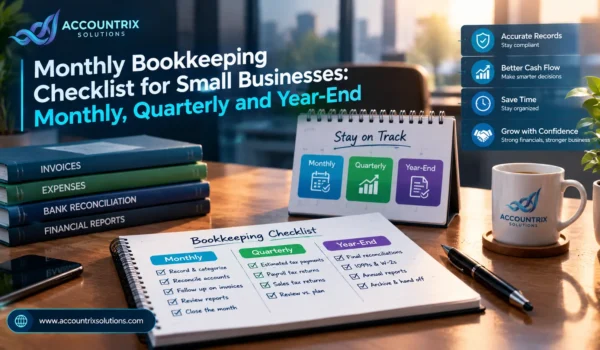
Monthly Bookkeeping Checklist for Small Businesses: Monthly, Quarterly and Year-End

  • Blog
  • October 13, 2026
  • 2 Views
Monthly Bookkeeping Checklist for Small Businesses

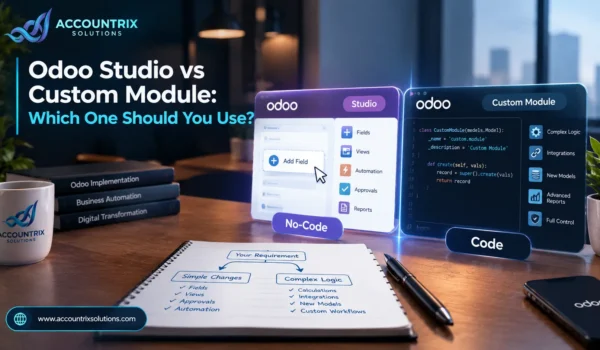
Odoo Studio vs Custom Module: Which One Should You Use?

  • Blog
  • October 13, 2026
  • 3 Views
Odoo Studio vs Custom Module

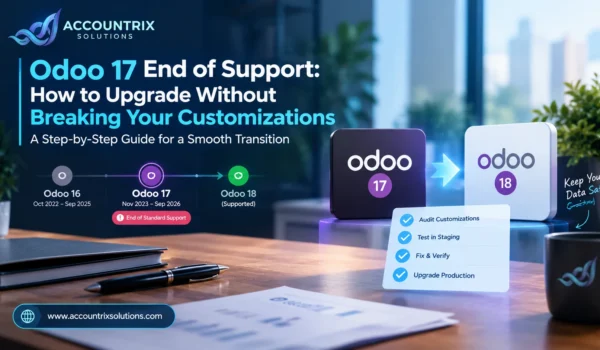
Odoo 17 End of Support: How to Upgrade Without Breaking Your Customizations

  • Blog
  • October 9, 2026
  • 4 Views
Odoo 17 End of Support

ACCOUNTRIX SOLUTIONS

Transforming workflows with tailored digital and accounting solutions.

Know More
Contact US

Get Started

  • Home
  • About Us
  • Blog
  • Contact

Odoo Services

  • Odoo Implementation
  • Odoo Customization
  • Odoo Integration
  • Odoo Migration

Bookkeeping Services

  • Digital invoicing
  • Odoo Bookkeeping
  • Quickbooks Bookkeeping
  • Zoho Bookkeeping

© 2026 All Rights Reserved | Designed by Ruman

Facebook Twitter Google-plus