-
October 13, 2026
-
4 Views
Odoo Studio vs Custom Module: Which One Should You Use?
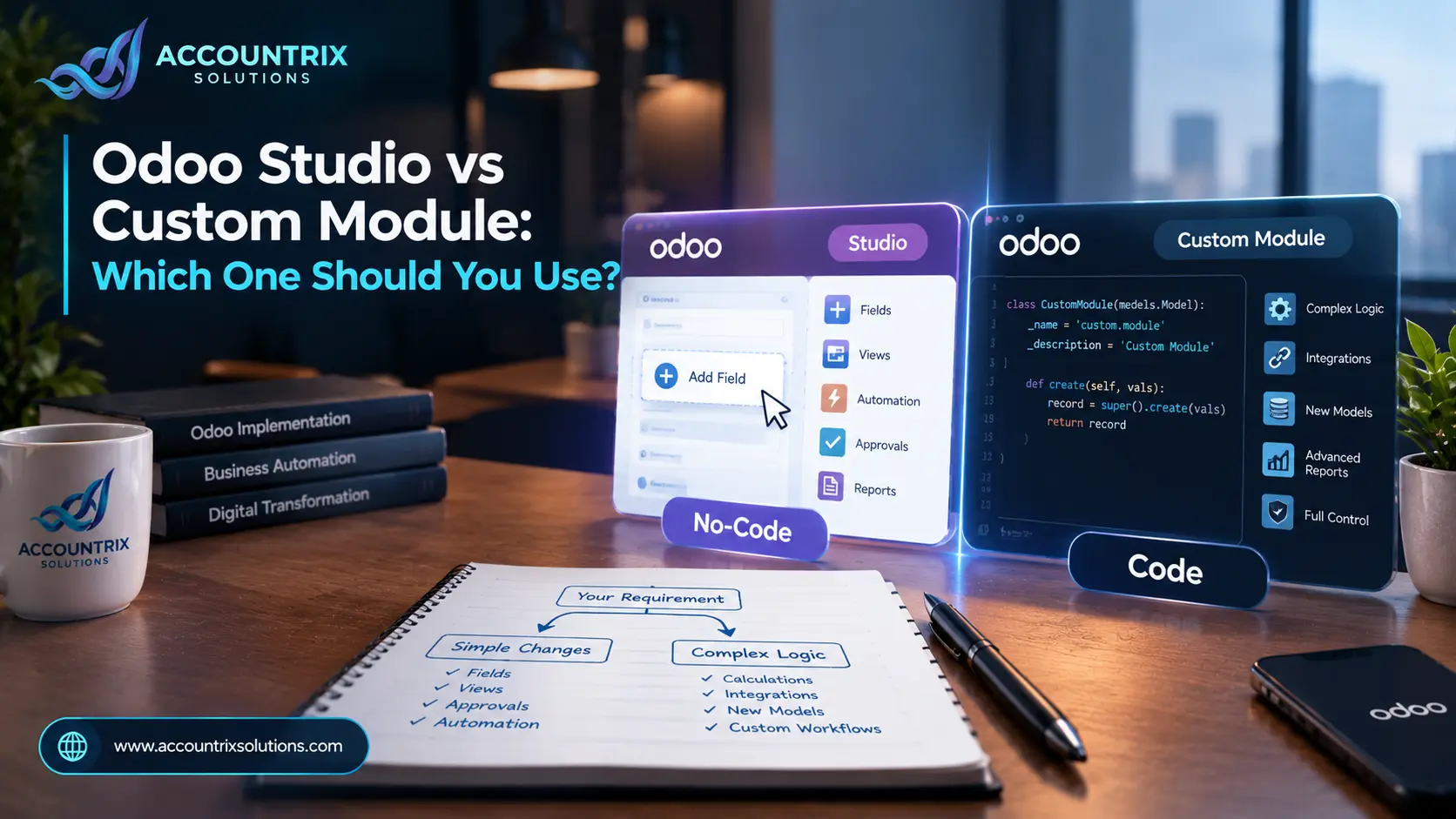
Use Odoo Studio when the change is about what people see or approve: fields, screens, simple automation rules, approvals and document layouts. Use a custom module when the change needs real logic, calculations or a two-way link with another system. Most businesses end up using both, and the skill is knowing which request goes where.
Studio fits when
- You want to add or move fields on a form
- You need a simple rule, like "when this happens, do that"
- You need an approval step or a different document layout
- You are on Odoo Online, where custom Python modules are not allowed
A custom module fits when
- The change needs calculations or conditions Studio cannot express
- You need a two-way connection with an outside system
- You run Community, which has no Studio
- You want the change kept in code with a clear owner
Every Odoo project reaches the same moment. Someone asks for a change that standard Odoo does not do, and you have to decide how to build it. The Odoo Studio vs custom module choice sounds technical, but it is mostly a business decision about speed, risk and what happens at your next upgrade.
This guide explains what each option really is, compares them side by side, gives you a three-question flowchart to decide, and shows how each one behaves when you upgrade, using Odoo's own documentation as the source.
What is Odoo Studio?
Odoo Studio is a built-in toolbox that lets you customize Odoo without writing code. You open any app, click the Toggle Studio button, and change the screen you are looking at. According to Odoo's Studio documentation, you can add or modify:
You can also build a small app from scratch. Studio is part of Odoo Enterprise and is not available in Community, so confirm that your plan includes it before you rely on it.
The big advantage is speed. A trained admin or consultant can make a change in an afternoon, and nobody needs a code repository. The limit is depth. Studio handles changes you can describe as add, show, hide, approve, notify or print. It does not replace a developer once the logic gets complicated.
Studio changes can also be exported as a module and imported into another database, which is handy when you move work from a test copy to production. The destination database needs the same Odoo version and the same apps installed, and Odoo documents the export and import steps.
If you are still setting Odoo up, get the standard configuration right first through proper Odoo implementation services. Many customization requests disappear once the settings are correct, and Studio then has far less to do.
What is a custom module in Odoo?
Odoo's own definition is simple. A custom module is any module that extends the standard code of Odoo and was not built with the Studio app, as the guide to upgrading a customized database puts it. In practice it is code, written in Python and XML, stored in a repository and installed alongside standard Odoo.
That code can do almost anything: new data models with complex rules, calculations that depend on many records, scheduled jobs, new screens and connections to other systems. The price of that freedom is ownership. Someone has to maintain the code, test it on every new Odoo version, and fix it when something changes.
Connections to other systems deserve special care. A one-off script that talks to a store, courier or payment tool tends to break at the next upgrade, while a planned connection built through Odoo integration services is designed to survive it.
Where you can use one also depends on hosting. Odoo states that installing custom modules containing Python files is not allowed on Odoo Online databases. Odoo.sh and on-premise installations do allow them.
Odoo Studio vs custom module: what is the difference?
The table below shows where each option fits. Read it as a guide rather than a rulebook, because details shift between Odoo versions.
Which options does your setup allow?
Your hosting and edition decide what is even possible, so check this before you plan anything. Here is how the common setups line up.
If you are not sure which setup you run, ask your host, or have a partner who provides Odoo customization services confirm it before you plan any work. The answer decides which options are even on the table.
How do you choose? A three-question flowchart
Run every change request through these questions in order. Stop at the first yes.
If you land on the Studio answer but run Community, the same request becomes a small custom module instead. The flowchart tells you the right type of change. Your edition tells you how to build it.
Real requests and the best fit
Here is how the flowchart plays out on requests we see all the time.
The pattern is easy to spot. Presentation and simple rules go to Studio. Logic and other systems go to code. One more check applies to both: the commission example touches money, so an accountant should review it before go-live. Our Odoo bookkeeping team does this kind of review, because a wrong account in a custom rule can quietly distort your reports for months.
What happens to each one at upgrade time?
This is where the choice really shows up. For databases on Odoo Enterprise, Odoo's upgrade documentation says the upgrade service covers customizations created with Studio, as long as Studio is still installed and the subscription is active. Custom modules are treated differently. Modules created in-house or by third parties are not covered, unless they fall under a maintenance of customizations subscription.
Studio customizations
- Covered by Odoo's upgrade service while Studio stays installed and the subscription is active
- Still need testing, especially reports and automation rules
- Can be exported as a module if you need a copy
Custom modules
- Not covered unless you hold a maintenance contract
- Must exist for the target version before the database can be upgraded
- Need a developer who knows the code
That second rule catches people out. If your database contains custom modules, it cannot be upgraded until a version of those modules exists for the target version. That makes custom code the critical path on most upgrade projects, and it is the main reason to keep the number of modules small.
Studio is easier at upgrade time, but it is not a free pass. Always test the upgraded copy before you touch production. If an upgrade is on your calendar, start with an inventory of every customization, and bring in Odoo migration services early so Studio changes and custom code are audited together.
The cost you do not see on day one
A custom module often looks cheap at the start, because the build is a single quote. The real cost is spread across every upgrade and every change of staff. Studio flips that picture. It can look more limited, but it usually costs less to carry. Here is how the two compare across the life of a customization.
The hybrid approach most businesses end up with
You rarely have to pick one forever. A sensible setup uses both, with clear rules about which goes where.
A register does not need to be fancy. A shared sheet with six columns is enough:
- The name of the customization
- Its type, Studio or custom module
- The business reason it exists
- The person who owns it
- Anything it depends on, such as another module or an outside system
- The Odoo version you last tested it on
Mistakes that make customizations expensive
- Customizing before configuring. A setting you never opened often does the job.
- Hiding logic inside Studio. A long Python action inside an automation rule is custom code with no repository and no owner.
- Building a module for a simple field. You pay for code, testing and upgrades just to show one extra box.
- No owner and no record. Six months later nobody knows why a change exists, so nobody dares remove it.
- Skipping the review at upgrade time. New versions often cover what you built by hand.
When it makes sense to bring in help
A good partner does two things before writing any code. They check whether standard Odoo already covers the need, and they decide whether Studio or a module is the better fit. That review costs far less than building the wrong thing.
Whoever you work with, ask these four questions before any build starts:
- Does standard Odoo already cover this?
- Why Studio, or why a module, for this request?
- Who owns it after go-live?
- What happens to it at the next upgrade?
If the answers are vague, slow down. A short conversation now saves a long project later.
Frequently asked questions
Can I use Odoo Studio on Odoo Community?
No. Studio is part of Odoo Enterprise. On Community, customization is done with custom modules.
Can I install custom modules on Odoo Online?
No. Odoo states that installing custom modules containing Python files is not allowed on Odoo Online databases. Odoo.sh and on-premise installations support them.
Does Odoo Studio write code?
Studio works through a visual interface, so you do not write code. An automation rule can run Python, though, and anything like that should be treated as custom code.
Will my Studio customizations survive an upgrade?
Odoo says its upgrade service covers them as long as Studio is still installed and the subscription is active. You should still test the upgraded copy before production.
Can I move Studio changes to another database?
Yes. Studio can export your customizations as a module that you import into another database, as Odoo's Studio documentation describes.
Which one is cheaper?
Studio changes are usually quicker to build and cheaper to carry through upgrades. A custom module costs more to build and maintain, but it does things Studio cannot. The cheapest option is the one that fits the request.
Can I use both in the same database?
Yes, and most businesses do. Keep a register of what lives where so upgrades stay predictable.
Final thoughts
The Odoo Studio vs custom module decision is rarely about which tool is better. It is about matching the request to the right tool, and remembering that every customization has to survive the next upgrade. Start with standard settings, use Studio for what people see, use code for real logic, and keep a record of all of it.
If you want a second opinion on a customization you are planning, talk to the team at Accountrix Solutions. We will tell you honestly whether Studio, a module or no customization at all is the right answer.
Top Category
- Blog (12)
Recent Posts
Bookkeeping vs Accounting: Which Does Your Business Need?
Odoo Studio vs Custom Module: Which One Should You Use?
Popular Tag
Related Articles
Bookkeeping vs Accounting: Which Does Your Business Need?
-
October 14, 2026
-
3 Views
Monthly Bookkeeping Checklist for Small Businesses: Monthly, Quarterly and Year-End
-
October 13, 2026
-
3 Views
Odoo 17 End of Support: How to Upgrade Without Breaking Your Customizations
-
October 9, 2026
-
5 Views
Leave a comment