-
October 7, 2026
-
8 Views
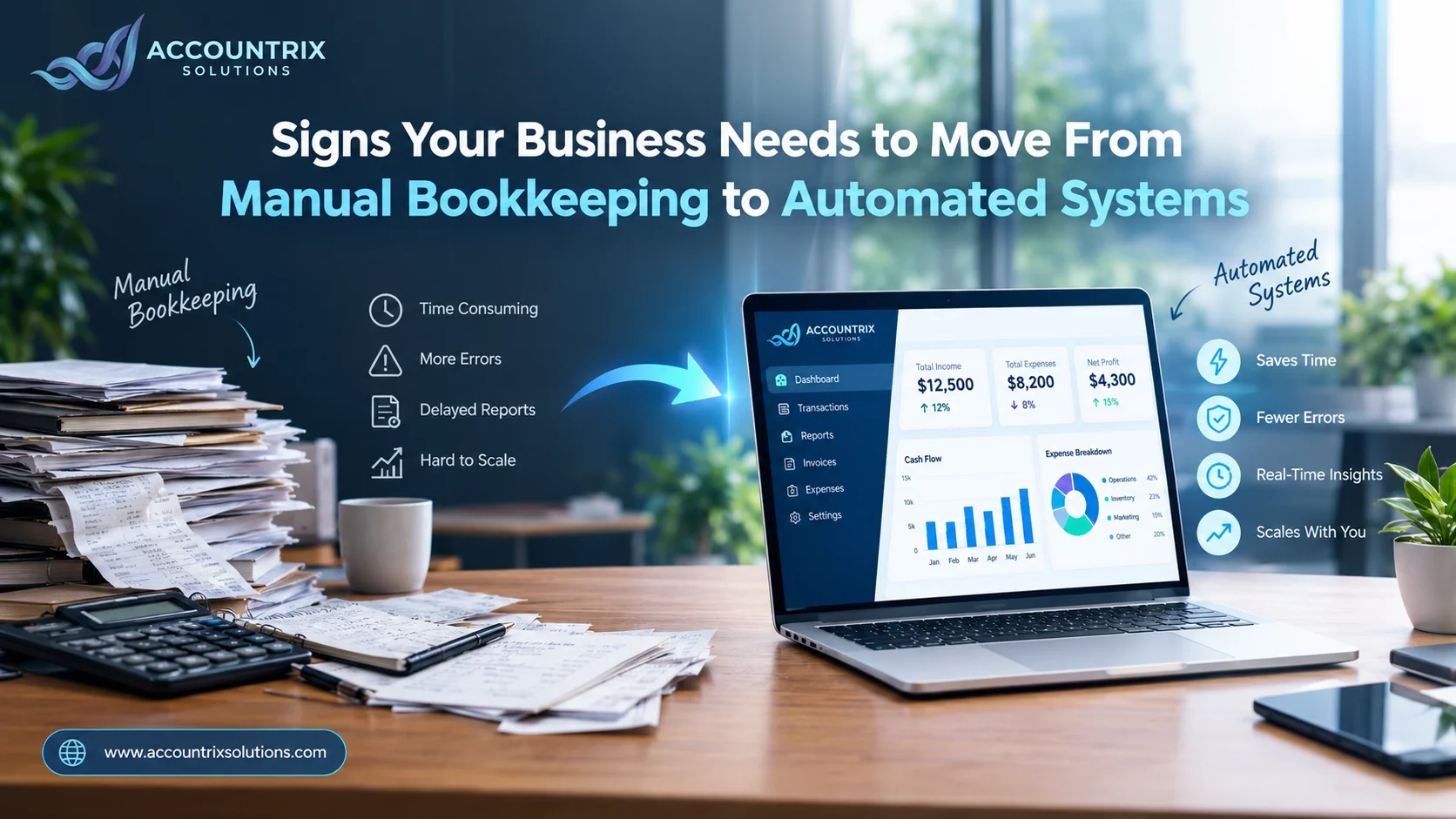
Signs Your Business Needs to Move From Manual Bookkeeping to Automated Systems
Your business is ready to move from manual bookkeeping to automated systems when you are spending several hours a week on data entry, catching the same errors repeatedly, waiting too long to see accurate numbers, or struggling to keep up as transaction volume grows. If two or more of these sound familiar, automated bookkeeping will likely save you more than it costs.
If you are asking whether it is time to move your business off manual bookkeeping, there is a good chance the answer is already yes. Most business owners do not switch the moment they should. They switch months later, after a missed invoice, a reconciliation that took an entire weekend, or a tax season that felt far more stressful than it needed to be, usually after telling themselves for a while that things would get easier on their own.
This guide walks through the clearest signs that manual bookkeeping has stopped working for your business, what automated bookkeeping actually changes day to day, and how to choose the right setup once you decide to make the move. None of this requires guessing. The signs tend to be fairly consistent across businesses, which makes them easy to check against your own operations honestly.
Why this decision matters more than it seems
Manual bookkeeping is not inherently wrong. Plenty of very small businesses run on it just fine for years, and there is nothing wrong with starting there. The problem is not the method itself, it is outgrowing it without noticing, since the shift tends to happen gradually rather than all at once, one extra client or one extra product line at a time, until the system that used to work quietly stops.
Research from McKinsey found that employees spend roughly 45 percent of their working time on manual tasks that could realistically be automated, source: McKinsey & Company. Bookkeeping, with its repetitive data entry and recurring monthly tasks, sits squarely inside that category for most small businesses.
These figures come from aggregated small business bookkeeping research published by ZipDo, and they line up with what most business owners already sense but rarely stop to measure.
9 signs it is time to automate your bookkeeping
A quick scenario worth recognizing
Consider a small service business that started with a handful of clients and a simple spreadsheet. Tracking a few invoices a month took no real effort, and the owner handled it personally between other tasks without much friction.
Two years later, the client list has tripled, there are recurring subscriptions, one off projects, and a part time contractor to pay. The same spreadsheet is still technically working, but updating it now takes several hours every week, mistakes are easier to miss, and the owner has started dreading the monthly reconciliation instead of simply doing it.
Nothing about this business did anything wrong. It simply grew past the point where its original bookkeeping method could keep up, which is exactly the pattern behind most of the nine signs above.
Manual bookkeeping vs automated systems
- Data entryTyped in by hand, transaction by transaction
- Error exposureRises with transaction volume
- ReconciliationOften a monthly, time heavy task
- Financial visibilityDelayed, often weeks behind
- ScalabilityGets harder as the business grows
- Owner time requiredHigh and ongoing
- Data entryPulled automatically from connected accounts
- Error exposureReduced through automated matching and rules
- ReconciliationFrequently updated in real time or daily
- Financial visibilityCurrent, available on demand
- ScalabilityScales with the business with little added effort
- Owner time requiredLower once the system is set up properly
What moving to automated bookkeeping actually involves
The idea of switching systems can sound more disruptive than it actually is, and a lot of business owners delay the decision simply because they picture it as a bigger project than it usually turns out to be. In practice, it usually follows a predictable path.
The heaviest lifting happens once, during setup. After that, the system is designed to carry most of the weekly workload on its own.
Choosing the right automated setup for your business
Not every business needs the same solution, and the right starting point depends on how your operations actually run day to day, not on which platform happens to be the most talked about. The goal is matching the tool to your business, rather than reshaping your business around a tool that does more than you need.
If your needs are mainly financial, a dedicated bookkeeping setup on a platform you already use is usually the fastest path. Our QuickBooks bookkeeping services and Zoho bookkeeping services are both built for businesses that want accurate, automated books without changing how the rest of the business operates.
If your business also manages inventory, multiple departments, or production alongside its finances, a connected setup through Odoo bookkeeping tends to offer far more long term value, since accounting stays linked to the rest of your operations instead of sitting in a separate tool. For businesses planning a fuller rollout, proper Odoo implementation services ensure that transition is handled correctly from day one.
Why this shift is accelerating in 2026
Bookkeeping automation is not a new idea, but the pace of adoption has picked up noticeably. More banks now offer direct, reliable data feeds, and accounting platforms have gotten better at automatically categorizing transactions correctly on the first pass rather than needing constant manual correction. Businesses that automated a few years ago are seeing more value from it than earlier adopters did, simply because the tools themselves have matured.
This also means the gap between manually tracked books and automated ones keeps widening. A business still relying on spreadsheets in 2026 is not just missing out on convenience. It is increasingly working with a noticeably slower, more error prone process than competitors who made the switch.
Frequently asked questions
Final thoughts
Most businesses do not wake up one day and decide to automate their bookkeeping. They notice, slowly, that the manual system they started with no longer matches the business they are running now. If two or more of the signs above sound familiar, that is usually the clearest indicator that the switch is overdue rather than premature.
If you are ready to move from manual bookkeeping to automated systems, get in touch with Accountrix Solutions and we will help you figure out the right setup for how your business actually operates.
Top Category
- Blog (12)
Recent Posts
Bookkeeping vs Accounting: Which Does Your Business Need?
Odoo Studio vs Custom Module: Which One Should You Use?
Popular Tag
Related Articles
Bookkeeping vs Accounting: Which Does Your Business Need?
-
October 14, 2026
-
3 Views
Monthly Bookkeeping Checklist for Small Businesses: Monthly, Quarterly and Year-End
-
October 13, 2026
-
3 Views
Odoo Studio vs Custom Module: Which One Should You Use?
-
October 13, 2026
-
4 Views
Leave a comment