-
October 6, 2026
-
10 Views
ERP vs Accounting Software: Which One Does Your Business Actually Need?
At some point, almost every growing business asks the same question. Do we need better accounting software, or do we actually need a full ERP system? The two get talked about as if they are the same kind of purchase, but they solve very different problems, and picking the wrong one can either waste your budget on capability you do not use, or leave your team stuck juggling the same disconnected tools you already have.
This guide breaks down the real difference between accounting software and an ERP system, the signs that point to each one, and how to avoid the two most common mistakes businesses make in this decision. Whether you end up needing simple bookkeeping support or a full ERP rollout, understanding the difference first will save you time, money, and a lot of second guessing later.
What accounting software actually does
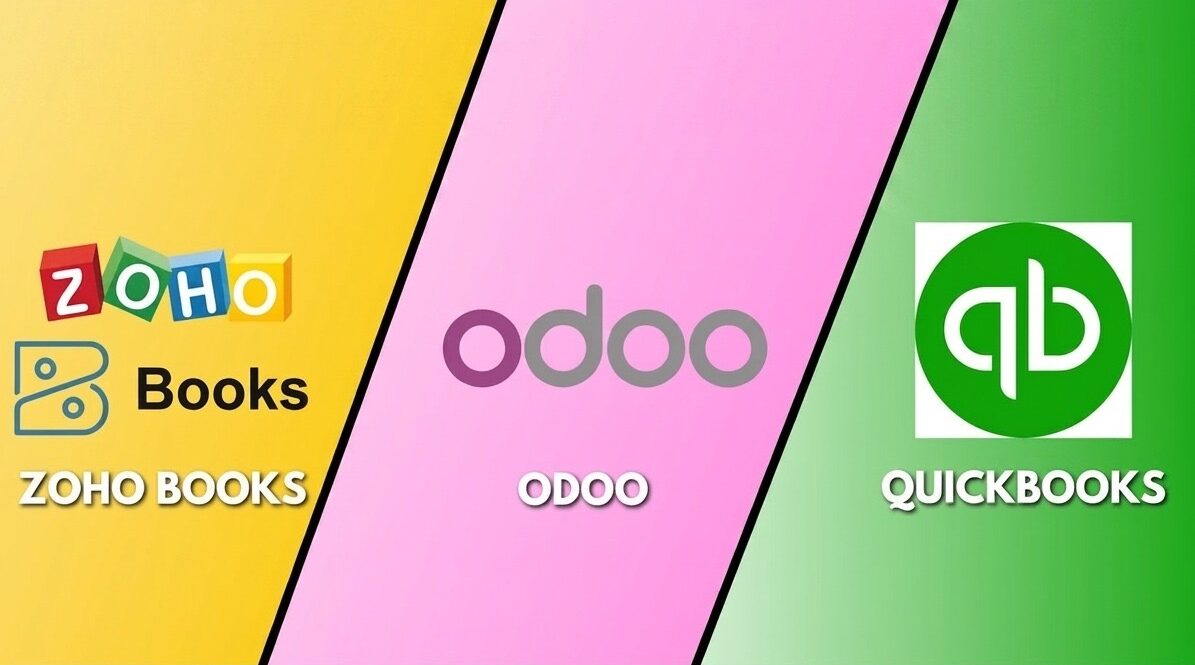
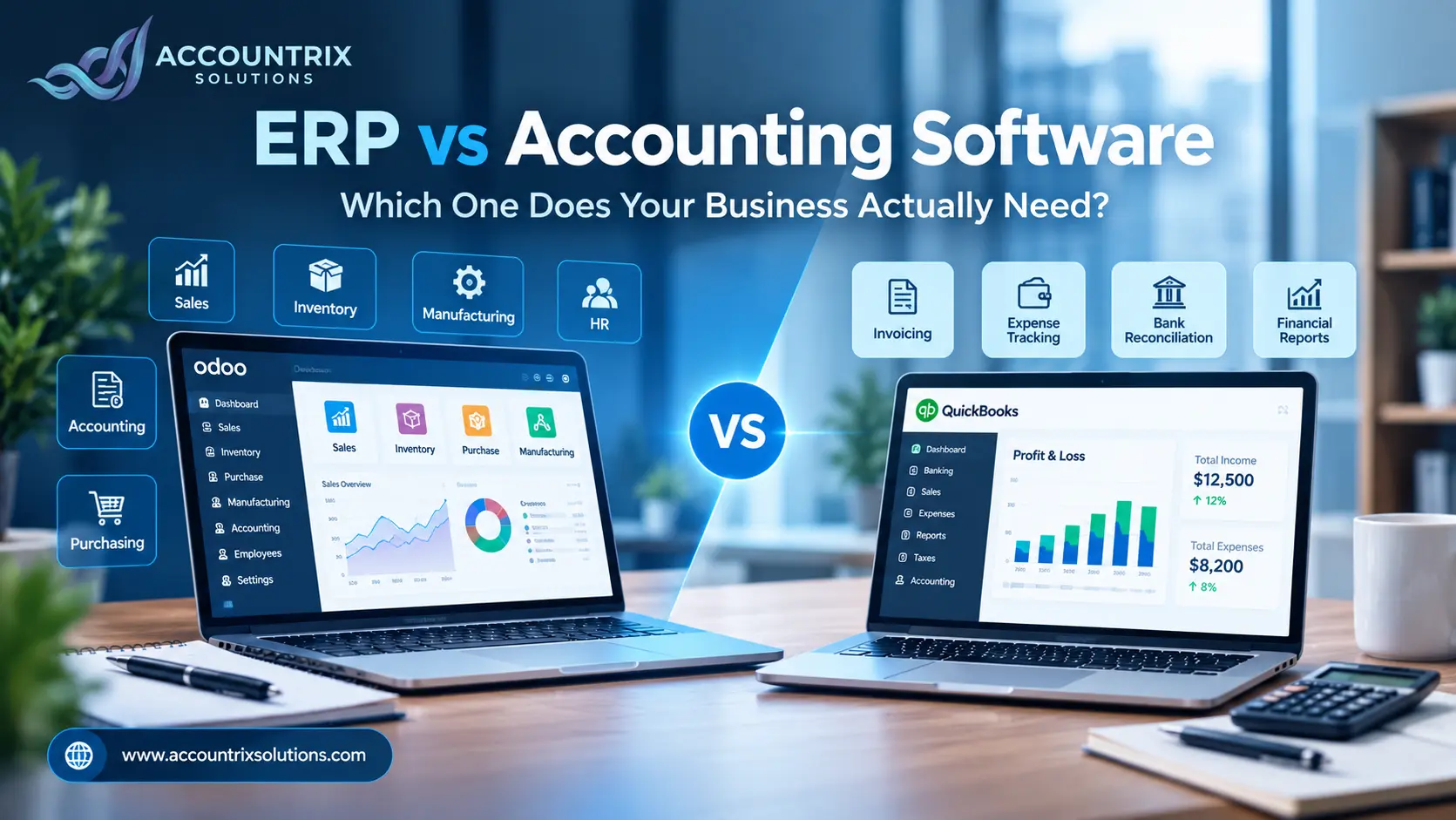
Accounting software is built to do one job well: manage your money. That includes invoicing, expense tracking, bank reconciliation, payroll in some cases, and financial reporting. Tools like QuickBooks and Zoho Books fall into this category. They are focused, relatively quick to set up, and usually priced to fit a small business budget.
The limitation is also built into the design, not a flaw to be fixed in a future update. Accounting software generally does not manage inventory in any real depth, does not coordinate manufacturing or production, and was never meant to run your entire operation. It tracks the financial result of your business, not the day to day operations that produce that result.
What an ERP system actually does
An ERP system, short for enterprise resource planning, is built to run the operational side of a business, not just the financial side. A platform like Odoo connects sales, inventory, purchasing, manufacturing, HR, and accounting into one system, so data only has to be entered once and every department works from the same information instead of maintaining its own separate version of the truth.
This is the core difference most comparisons miss. Accounting software asks what happened with your money. An ERP system asks how your entire business actually works, and then connects every part of it so nothing has to be manually reconciled between separate tools.
ERP vs accounting software: a side by side comparison
Numbers aside, here is how the two actually compare on the things that matter most when you are making this decision.
| Factor | Accounting Software | ERP System |
|---|---|---|
| Primary focus | Financial transactions and reporting | Entire business operations, finance included |
| Inventory management | Basic or not included | Fully built in and connected to sales |
| Departments covered | Finance only | Sales, inventory, HR, manufacturing, and more |
| Setup time | Days to a few weeks | Weeks to a few months, depending on scope |
| Best for | Small teams with simple operations | Growing businesses with multiple moving parts |
| Data entry | Often duplicated across separate tools | Entered once, shared across departments |
| Cost structure | Lower upfront, scales with users | Higher upfront, scales with modules and complexity |
Signs you only need accounting software
- Your business is mainly services based, with little or no physical inventory
- You have a small team and a handful of departments at most
- Your biggest daily challenge is simply keeping the books accurate and current
- You are not juggling data between many different systems
- Your growth plans for the next year or two are steady rather than rapid
If this sounds like your business, a dedicated bookkeeping setup is usually the smarter move, not a bigger system you do not need yet. Spending months implementing modules you will barely touch rarely pays off. Our QuickBooks bookkeeping services and Zoho bookkeeping services are both built for exactly this kind of business, where accurate, well managed books matter more than a full operational overhaul.
Signs you actually need a full ERP system
- You manage physical inventory and are constantly double checking stock levels by hand
- Multiple departments rely on spreadsheets that do not talk to each other
- You are manually re entering the same data in more than one tool
- Manufacturing, production, or multi location operations are part of your business
- You have outgrown your current software but are not sure what comes next
If several of these sound familiar, the issue is not your bookkeeping, it is that your operations have grown past what accounting software was ever meant to handle. This is usually where businesses look into proper Odoo implementation services, since the goal at that point is connecting the whole business, not just managing the books.
What about total cost over time
It is tempting to compare the two purely on sticker price, but that rarely tells the full story. Accounting software looks cheaper upfront and often stays that way if your operations genuinely stay simple. An ERP system costs more to set up, but it can quietly save money over time by removing duplicate data entry, reducing errors between disconnected systems, and cutting down the hours your team spends reconciling numbers that should have matched from the start.
The right way to think about cost is not which option has the smaller invoice today, but which option actually matches the complexity your business already has, since mismatched tools tend to cost more in wasted time than either platform costs in fees.
The two mistakes businesses make most often
Mistake 1: Buying an ERP system too early
Some businesses jump straight to a full ERP rollout because it sounds more impressive, or because a vendor convinced them it is the modern choice. If your operations are genuinely simple, this usually means paying for complexity you do not need yet, and spending months implementing features your team will barely touch.
Mistake 2: Staying on accounting software too long
The more common mistake is the opposite one. Businesses often stick with accounting software well past the point where it stopped being enough, simply because switching feels disruptive. The result is usually a patchwork of spreadsheets and workarounds trying to cover gaps that the software was never designed to fill in the first place.
Both mistakes come from the same root cause: deciding based on what feels safe or impressive, rather than what your actual day to day operations need right now. The honest fix in either case is the same. Look closely at how your business actually runs before choosing a tool, instead of working backward from a tool you already like the sound of.
The middle ground most businesses do not know about
Here is what a lot of comparisons leave out. You do not have to choose between a simple tool and a massive, all in one system on day one. Modular platforms like Odoo are built so you can start with just accounting and a couple of core modules, then add inventory, manufacturing, or HR later as your business actually grows into needing them.
This matters because it removes the pressure of trying to predict your business three years from now. You can start with proper Odoo bookkeeping support today, and expand into fuller Odoo customization services or Odoo integration services later, without starting over from scratch or migrating your financial history all over again.
A quick scenario that makes the difference clearer
Picture a small retail business selling through both a physical store and an online shop. In the early days, QuickBooks or Zoho Books handles everything fine. Invoices go out, expenses get tracked, and the books stay accurate without much effort.
Fast forward a year. The business now tracks inventory across two locations, the online store needs to reflect real time stock levels, and someone on the team is manually updating a spreadsheet every evening to keep the numbers from two systems roughly in sync. Nothing about the accounting has gotten harder. What changed is that the operation around the accounting has grown past what accounting software alone was built to manage.
This is the exact point where a full ERP system starts to make sense, not because the business got bigger in revenue, but because it got more complex in how it actually runs day to day.
Why this decision matters more in 2026
Business tools are changing quickly, and automation is becoming a bigger part of daily operations than it was even a couple of years ago. Modern accounting platforms now offer smarter bank reconciliation and basic automation, which is great for businesses that only need financial management. Modern ERP systems go further, using automation to connect entire workflows, from a sales order triggering inventory updates to purchase orders generating automatically when stock runs low.
The gap between the two has not closed. If anything, it has become more noticeable, since ERP systems are automating operational work that accounting software was never built to touch in the first place. Choosing the right category now, rather than later, puts your business in a better position to actually benefit from where business software is heading.
How Accountrix Solutions can help either way
At Accountrix Solutions, we do not push every business toward the same answer. Our team works across both accounting platforms and full Odoo ERP implementations, so the advice you get is based on your actual operations, not on which service happens to be easier for us to sell.
- Need focused, reliable bookkeeping without a full system overhaul? We support QuickBooks and Zoho Books directly.
- Already outgrowing spreadsheets and disconnected tools? We handle full Odoo setups from planning through go live.
- Not sure which side of that line your business is on? That is exactly the kind of conversation worth having before you spend a dollar on either option.
Does my industry affect this decision?
Yes, more than business size does. Service based industries like consulting, marketing, or professional services often stay comfortable on accounting software far longer than product based businesses. Retail, distribution, and manufacturing businesses tend to hit the limits of accounting software much sooner, simply because inventory and production are core to how they operate every single day.
Frequently asked questions
Can accounting software eventually replace an ERP system?
Not really. Accounting software can grow more capable over time, but it is still built around managing finances. Once a business needs inventory, manufacturing, or multi department coordination, it has moved into needs that accounting software was never designed to cover.
Is switching from accounting software to an ERP system difficult?
It depends on how much data and history you are carrying over. With a planned approach, your financial history can move with you instead of starting from zero, which is a large part of what a proper implementation project is for.
Do small businesses ever need a full ERP system?
Yes, especially small businesses with physical inventory or production involved. Business size alone does not decide the answer. Operational complexity does.
What is the safest way to decide between the two?
Map out your actual daily operations first. If the honest answer is mostly invoicing and expense tracking, accounting software is likely enough. If the answer includes inventory, multiple departments, or manual data re entry across tools, an ERP system is worth a serious look.
How do I know if my business operations are complex enough for an ERP system?
A useful test is to count how many separate tools your team checks in a normal day just to get a full picture of the business. If sales, inventory, and finance each live in their own disconnected system, and someone has to manually combine them to see the real numbers, that complexity is usually a strong signal that an ERP system would save real time.
Final thoughts
The real question in the erp vs accounting software decision is not which option sounds more advanced. It is which one actually matches how your business operates today, with room to grow into tomorrow. Accounting software keeps your finances accurate and organized. An ERP system connects your entire operation so nothing has to be manually stitched together between tools that were never designed to talk to each other.
If you are still unsure which side of that line your business falls on, get in touch with Accountrix Solutions and we will walk through your actual operations together, honestly, before recommending either path.
Top Category
- Blog (12)
Recent Posts
Bookkeeping vs Accounting: Which Does Your Business Need?
Odoo Studio vs Custom Module: Which One Should You Use?
Popular Tag
Related Articles
Bookkeeping vs Accounting: Which Does Your Business Need?
-
October 14, 2026
-
3 Views
Monthly Bookkeeping Checklist for Small Businesses: Monthly, Quarterly and Year-End
-
October 13, 2026
-
3 Views
Odoo Studio vs Custom Module: Which One Should You Use?
-
October 13, 2026
-
4 Views
Leave a comment